
The complete guide
Choosing a Desktop World Globe, A Practical Buyer's Guide
The problem with flat maps
Most of us learned the world from a rectangle. Wall maps, atlas pages, phone screens. They are useful, but they all stretch the planet to make it lie flat, which is why Greenland looks like it could swallow Africa and why nobody has a good instinct for how close Alaska is to Russia.
A globe fixes that quietly. It does not teach you anything new so much as it stops teaching you something wrong. Spin it once and the relationships make sense: the Atlantic is narrower than you thought, Australia is further from everything than you thought, and the Pacific takes up a frankly unreasonable amount of the planet.
The catch has always been size. Traditional globes were built for libraries and classrooms, mounted in heavy wooden cradles that needed their own corner. That is fine if you have a corner. Most people do not. They have a desk with a laptop on it, or a shelf with about twenty centimetres of free space between the books and the shelf above.
That is the gap a 14 centimetre globe fills.
What a 14cm globe actually gives you
Fourteen centimetres across is roughly the size of a grapefruit. On a desk it occupies about the same footprint as a coffee mug and saucer, which means it can live permanently in the corner rather than being shuffled around every time you need the space.
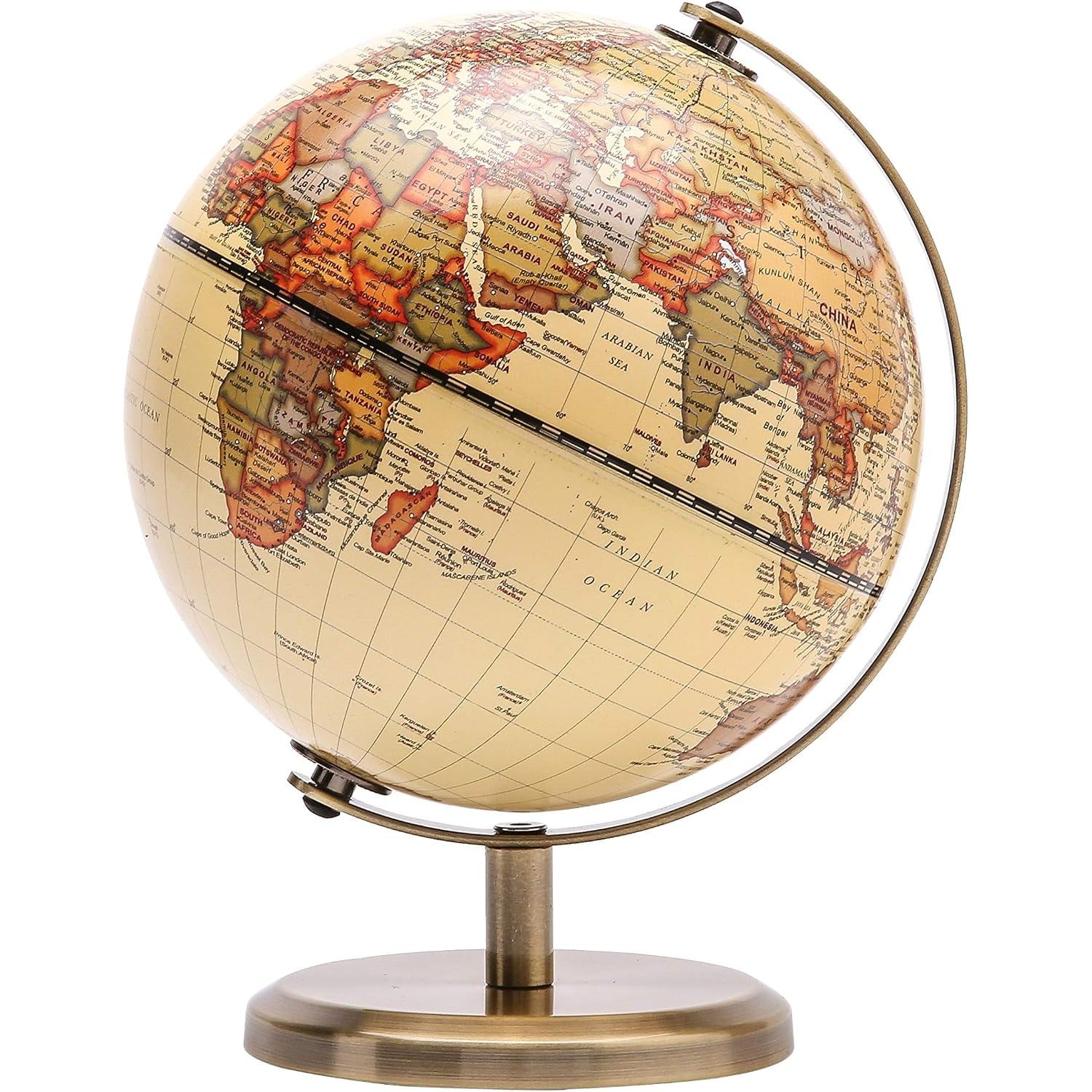
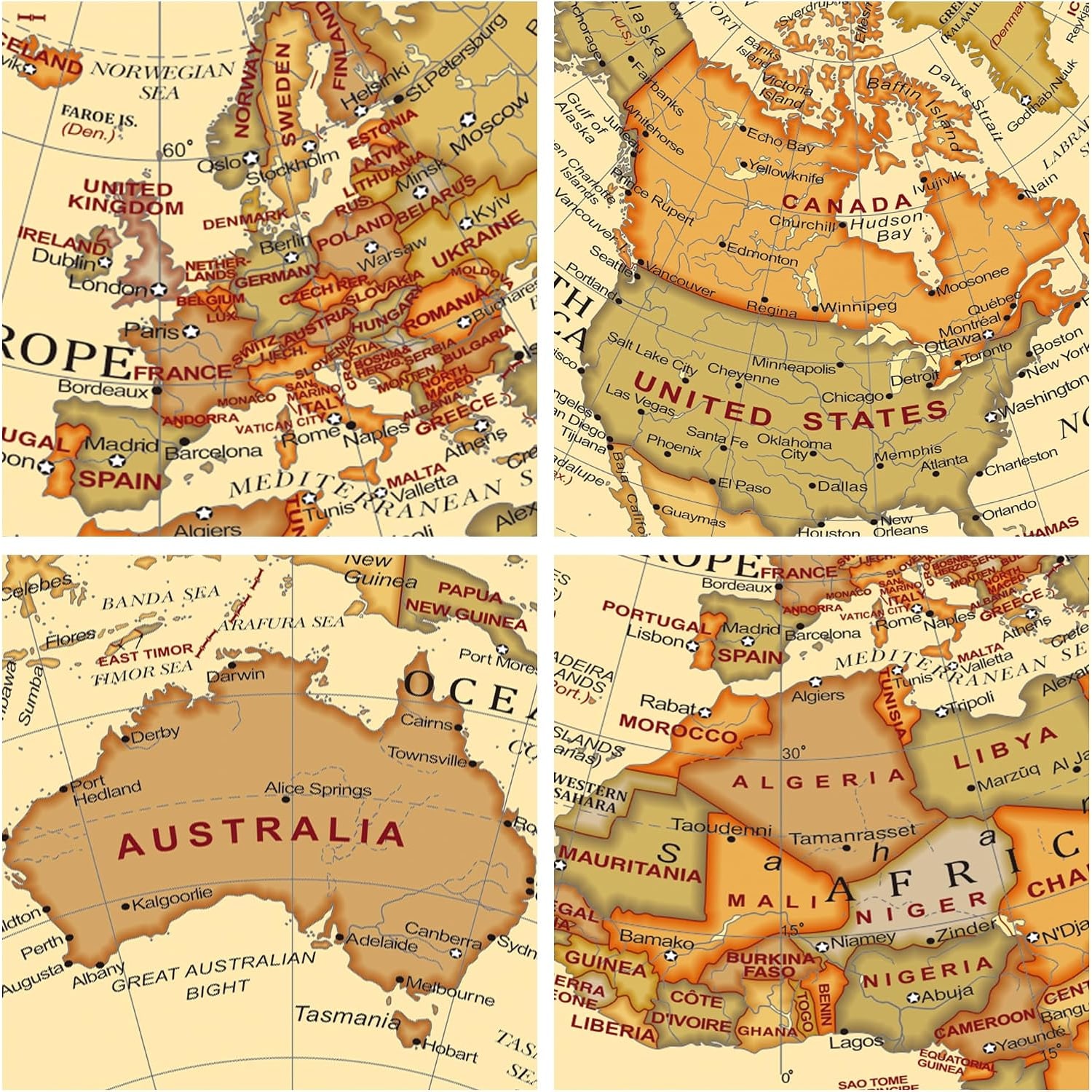
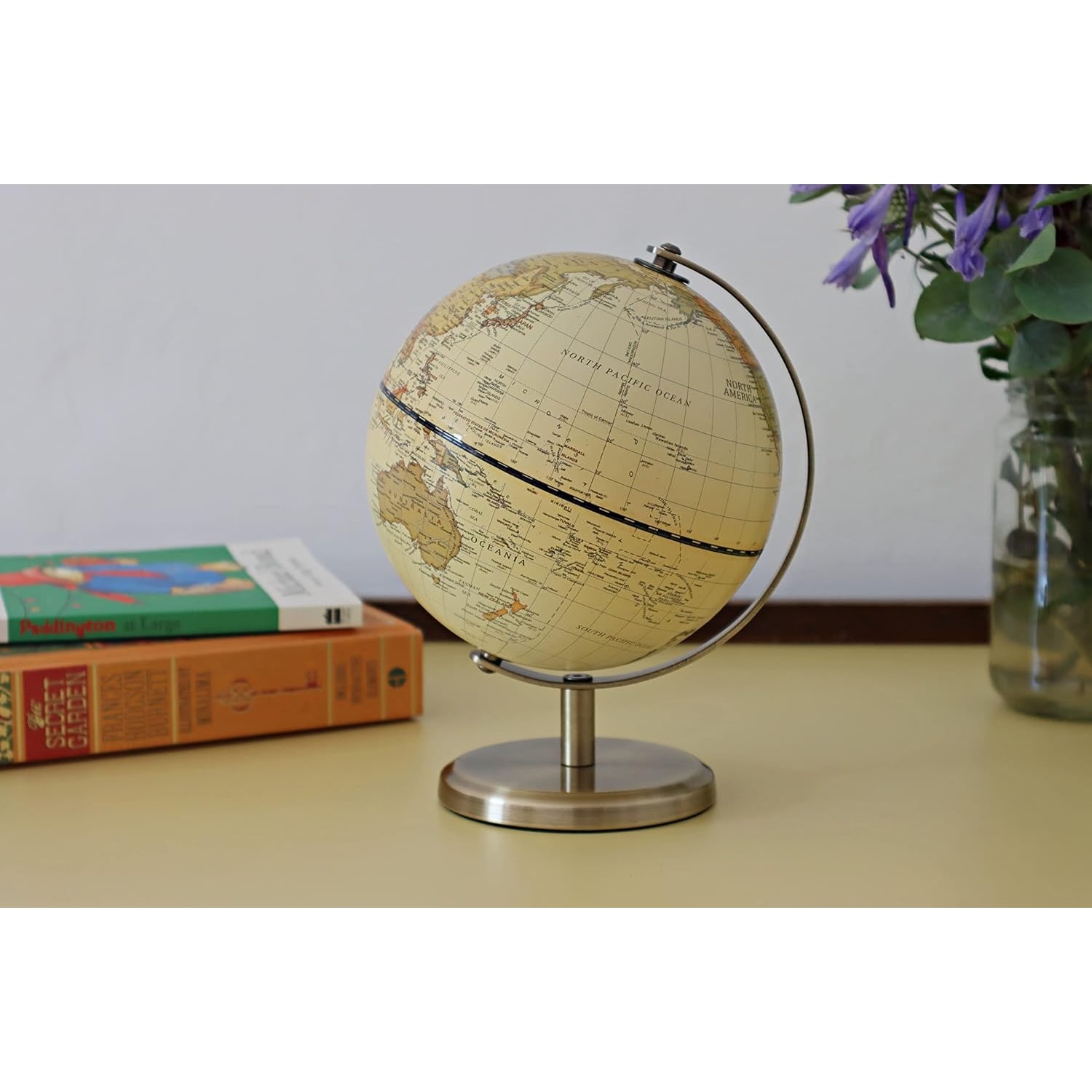
On that sphere you get an English political map in vintage colours. Political is the key word. Instead of shading hills and valleys, the map concentrates on countries, their borders, and their cities. That is the version most people actually want for everyday reference, because the questions we ask of a globe are usually about nations rather than terrain. Where does Chile stop and Argentina start. How many countries sit along the Baltic. What is between India and Thailand.
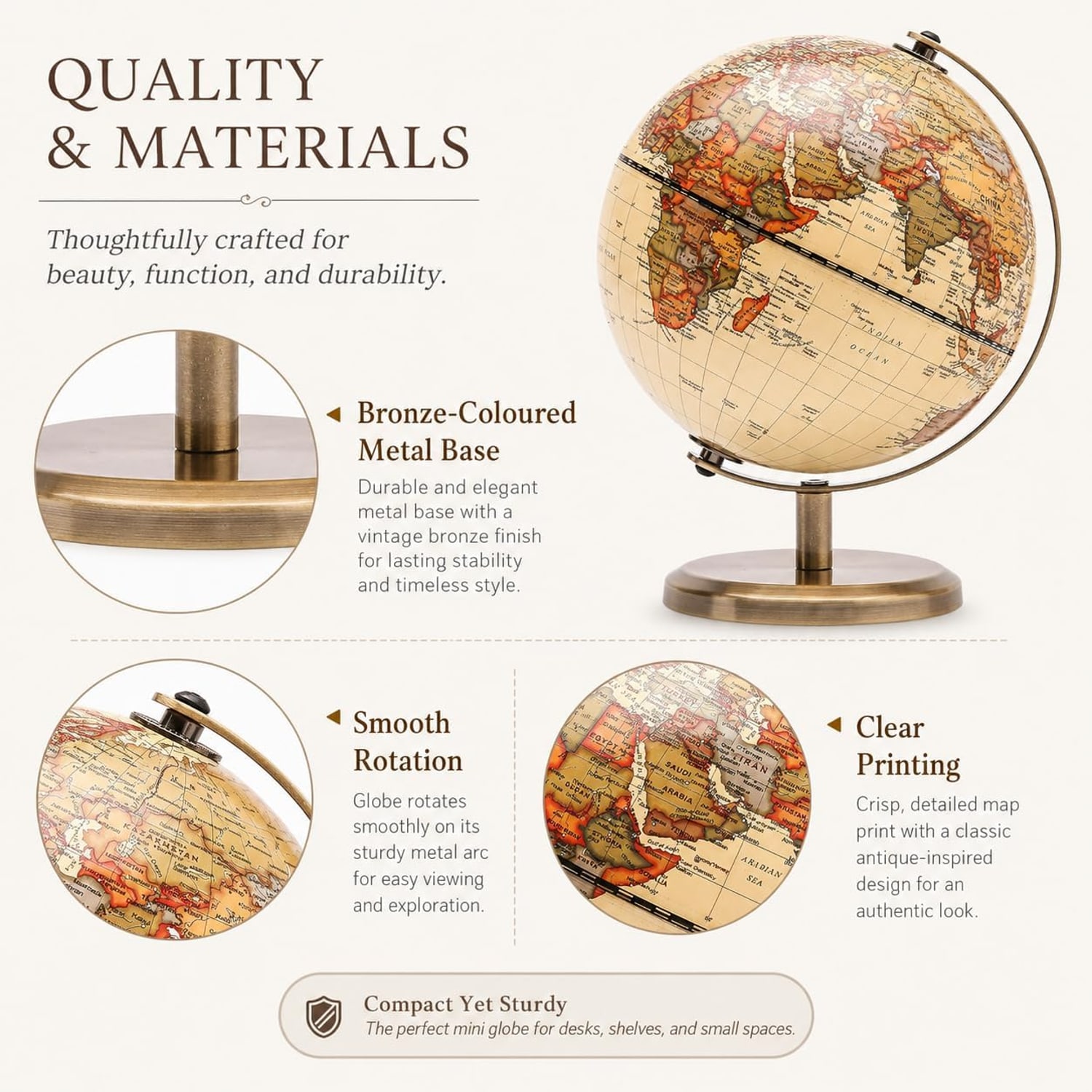
The vintage colour treatment matters more than you might expect. Modern globes often use bright, saturated fills that can look a bit like a classroom poster. A muted, aged palette reads as softer in a room and, oddly, is often easier on the eye for sustained reading because there is less contrast shouting at you.
The sphere sits in a polished metal arc on a metal base, both finished in a bronze tone. The metal is not just decoration. It gives the piece a low centre of gravity so it stays put when you spin it, and the arc holds the tilt so you are always looking at the world at a sensible angle rather than straight down at the pole.
Total weight is 0.38 kg. Light enough to carry from the study to the kitchen table when a homework question comes up, settled enough that a knock from a passing elbow does not send it across the desk.
How the rotation changes how you use it
This sounds obvious, but it is the single biggest difference between a globe that gets used and one that gathers dust.
Because the sphere turns, you stay seated. You spin, you find, you carry on with what you were doing. A fixed sphere or a wall map makes you get up and walk, and the small friction of getting up is enough that most people just reach for their phone instead.
A free-spinning globe also makes a better teaching object. If a child asks where somewhere is, handing them the globe and letting them find it themselves is a different kind of learning than pointing at a map on a wall. They turn it, they lose it, they find it again, and the hunt is what sticks. The best globe for a study is usually the one someone is allowed to touch.
Who this suits
People with small desks. If your working surface is already crowded, a 14 centimetre sphere is about the largest globe you can add without regretting it.
Students and home learners. Geography homework goes faster with a globe in reach. So does history, honestly, because so much of it is about who was next to whom.
Travellers and planners. There is something useful about tracing a route with a finger on a curved surface. Flight paths that look mad on a flat map make instant sense on a sphere.
Anyone filling an awkward shelf gap. A small globe is one of those objects that looks deliberate rather than like filler. It reads as interest rather than clutter.
Readers. Keep it beside the chair. Novels and non-fiction are full of place names, and looking them up on a map is a small pleasure that a phone search never quite matches.
How to choose between globe sizes
Think about reading distance first. A globe you look at from a metre away needs to be larger than one sitting an arm's length from your chair. At desk distance, 14 centimetres is comfortable for country names and major cities. Small island nations will be printed small, as they are on any globe short of the library-sized ones.
Then measure your space, and measure the height, not just the width. This is where most people come unstuck. A sphere plus an arc plus a base is taller than the sphere alone, so a shelf that looks roomy on paper can turn out to be too tight once the globe arrives. Allow a few centimetres of clearance above the top of the arc so you can lift it out without scraping.
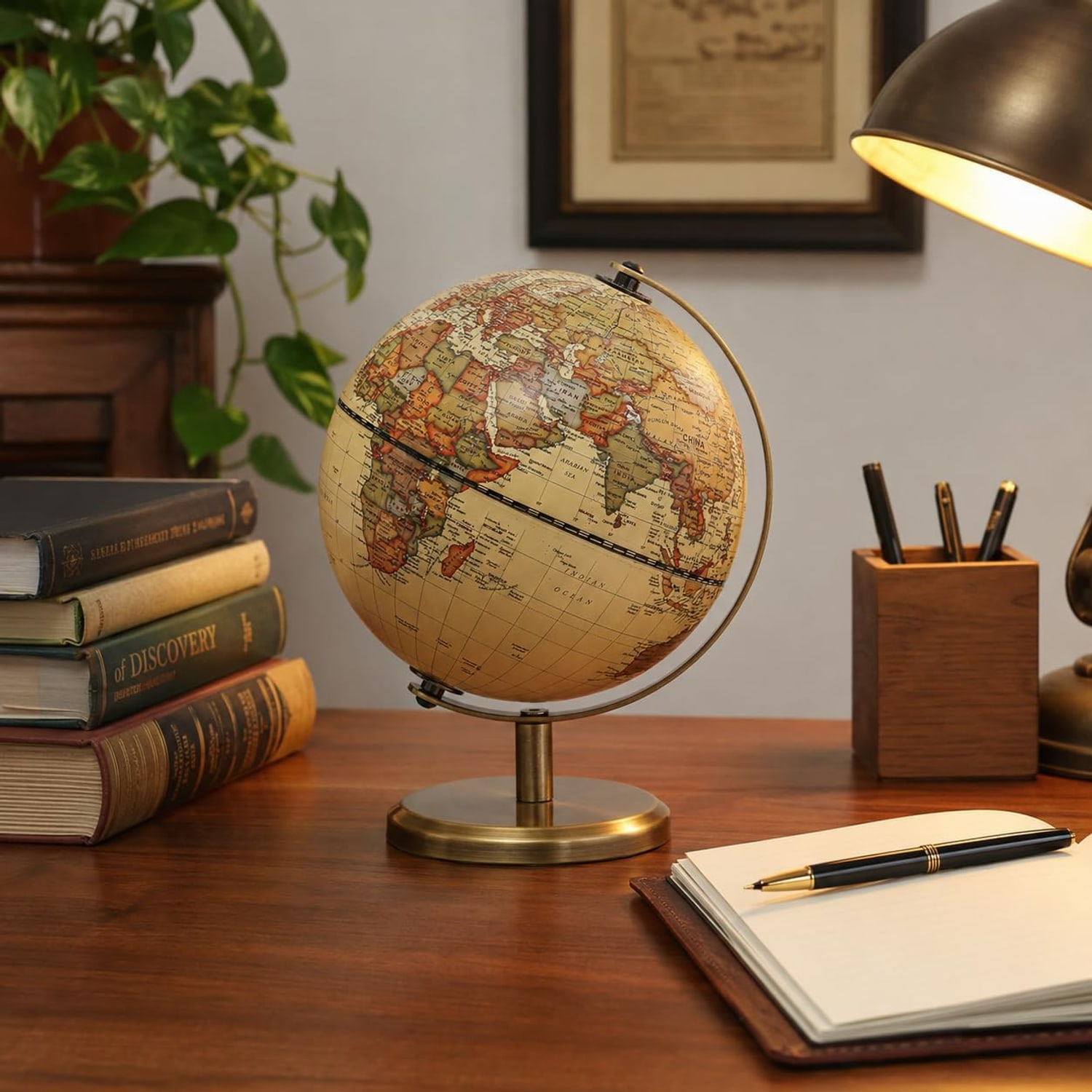
Consider the finish against what is already in the room. Bronze-tone metal sits naturally with wood, leather, brass lamps and older bookcases. Against a very white, very modern desk it works as a warm counterpoint rather than a match, which some people want and some do not.
Finally, be honest about whether you want a reference tool or an ornament. A globe can be both, and this one is designed to be both, but if you genuinely want to read small print all day then a larger sphere will always win. If you want something that answers questions and looks good doing it, compact is the smarter choice.
Looking after it
A printed globe asks for very little. Dust it with a soft dry cloth whenever you dust the shelf. If something marks the surface, a barely damp cloth will usually lift it, but dry it straight away. Printed paper surfaces and standing moisture do not get along.
For the metal, dry or lightly damp cloth, then buff dry. Skip the abrasive pads and the strong household sprays, which can take the shine off a polished finish faster than you would think.
Keep it out of hard, all-day sunlight. Any printed colour will fade eventually under direct sun, and a vintage palette has less contrast to spare than a bright one. A spot that gets bright indirect light is ideal.
When you move it, lift from the base rather than grabbing the sphere. The sphere is the part that spins, and repeatedly hauling it around by the sphere puts strain on the mounting points over the years.
Small things that make it better
Give it a surface of its own. A globe crammed between a monitor stand and a pen pot does not get spun, and a globe that does not get spun is just a round ornament. A clear few centimetres on each side is enough.
Put it where you sit, not where guests look. The best office desk globe is the one within arm's reach of your chair, not the one on the far bookshelf behind you.
If you have children in the house, keep it low enough that they can reach it. A globe at adult eye level is a thing to look at. A globe at child height is a thing to use.
The short version
A 14 centimetre antique style globe is the practical compromise between a map you can actually read and a desk you can actually work on. You get an English political map in vintage colours showing countries, borders and cities, mounted in a polished bronze-tone metal arc on a metal base, with a sphere that spins so you never have to leave your chair to find a place.
It weighs 0.38 kg, takes up about as much room as a mug, and does two jobs at once. Left alone it quietly furnishes a shelf. Picked up, it answers the question you were about to type into a search bar.
If your space is tight and your curiosity is not, this is the size that works.