
The complete guide
How to Choose a Kids Study Desk and Chair Set That Actually Gets Used
The pile on the kitchen table
Most homes start the same way. Homework happens at the kitchen table, the pencils live in a jar that migrates, and the reader folder ends up under a cereal box. It works, right up until it does not. Someone wants to eat, the books get stacked on a chair, and tomorrow morning the maths sheet is missing.
A kids study desk fixes a surprisingly small problem in a surprisingly useful way. It gives school things a fixed address. The pencils go back in the same place. The reader goes in the same cube. Nobody has to clear the desk at six o'clock because dinner is coming.
That is the real argument for a children's desk with drawers. It is not about creating a tiny office. It is about cutting the number of decisions a child has to make before they can start working.
What this set actually is
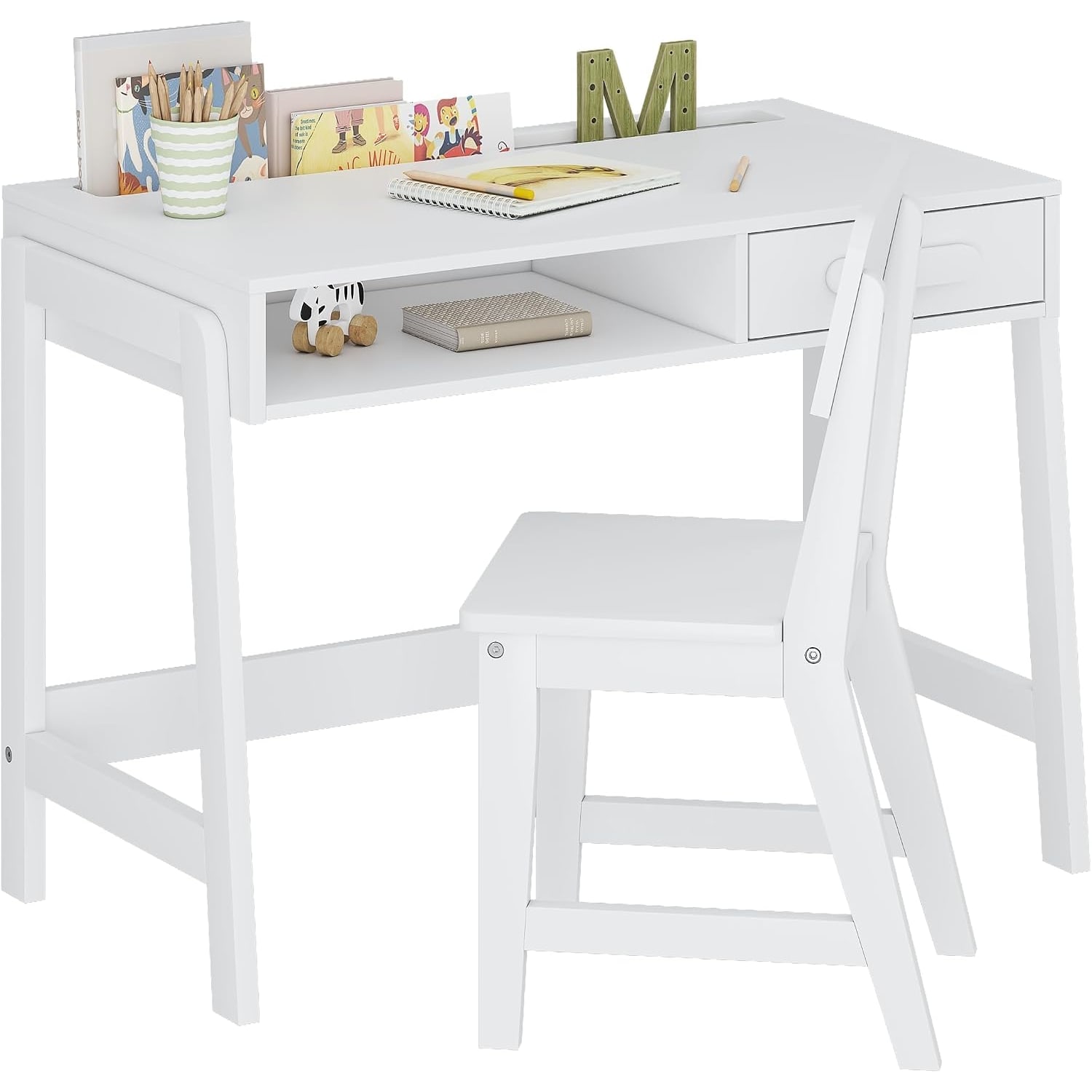
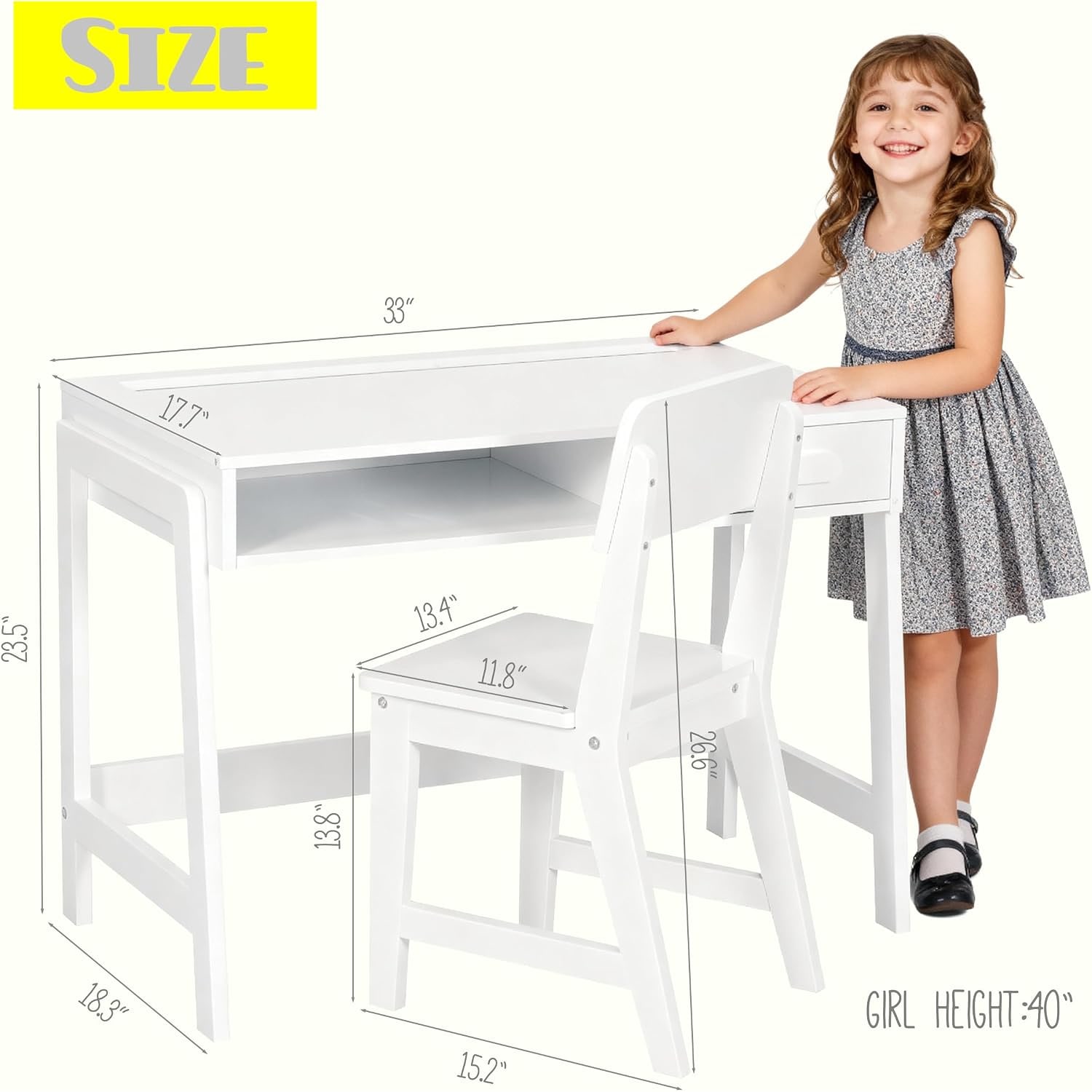
This is a two-piece set, a desk and a matching chair, that arrives flat-packed. The overall product dimensions are 45 cm deep, 83.8 cm wide and 59.7 cm high. The desktop, frame and base are engineered wood with a painted finish, standing on metal legs in a freestanding leg base. The top is walnut brown and the base is white.
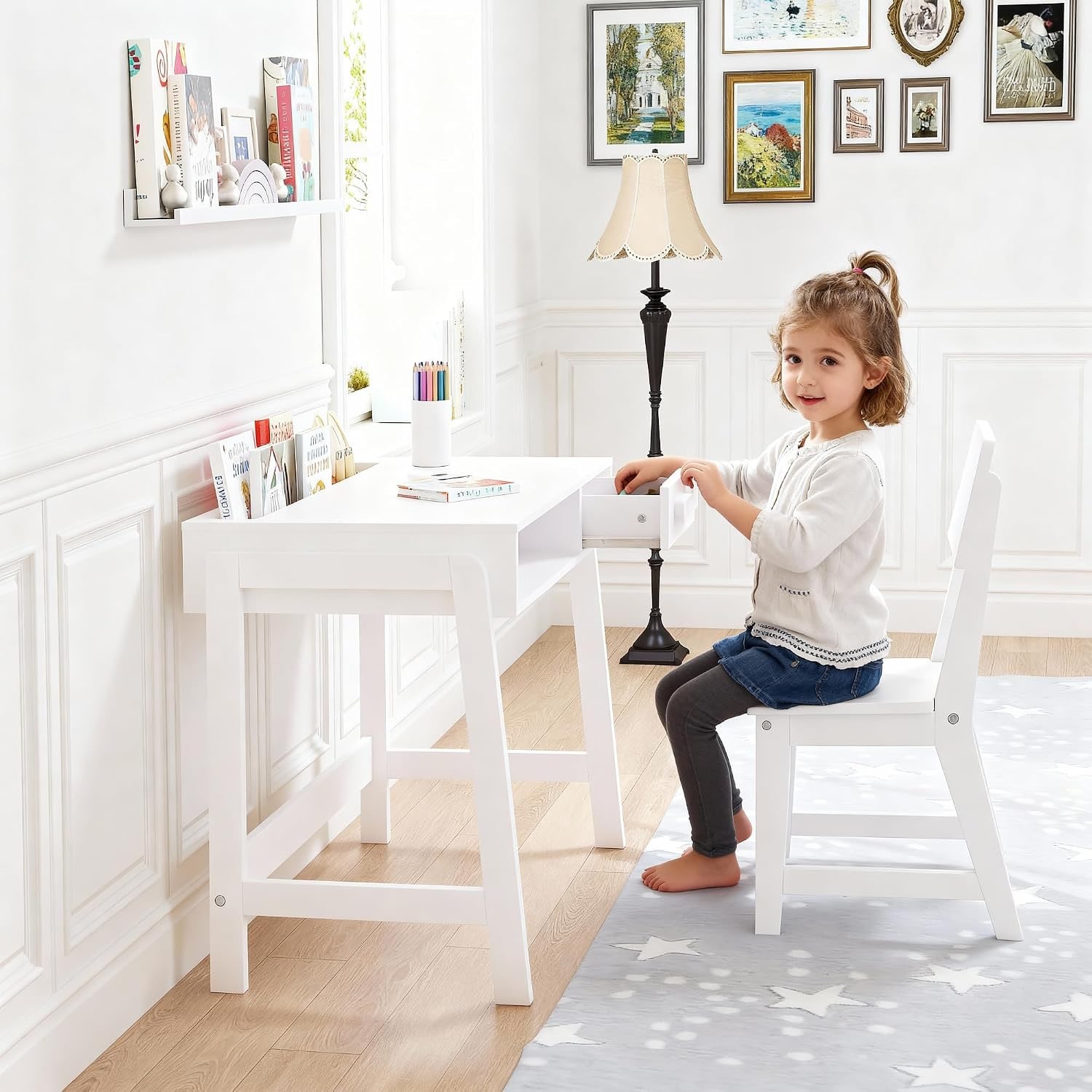
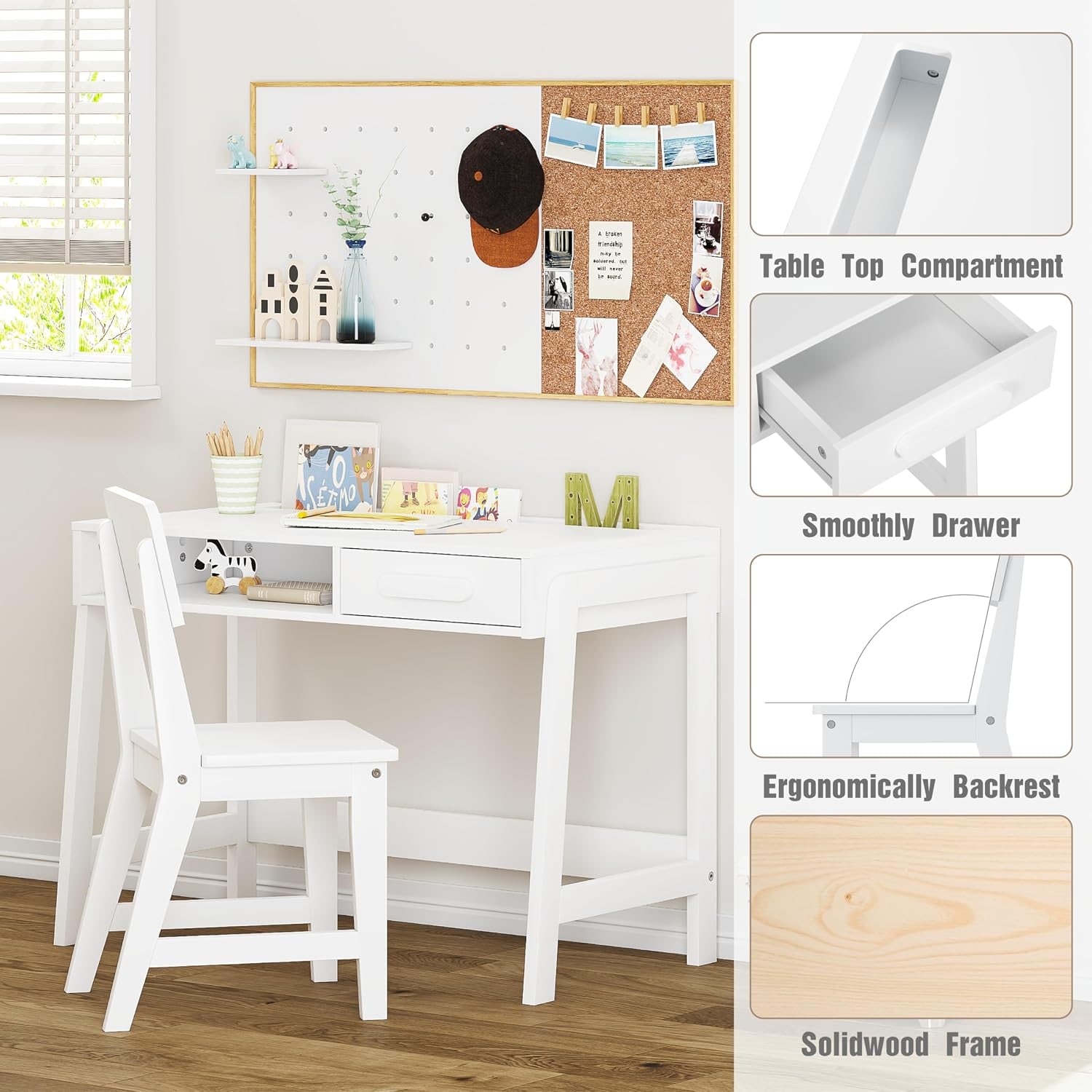
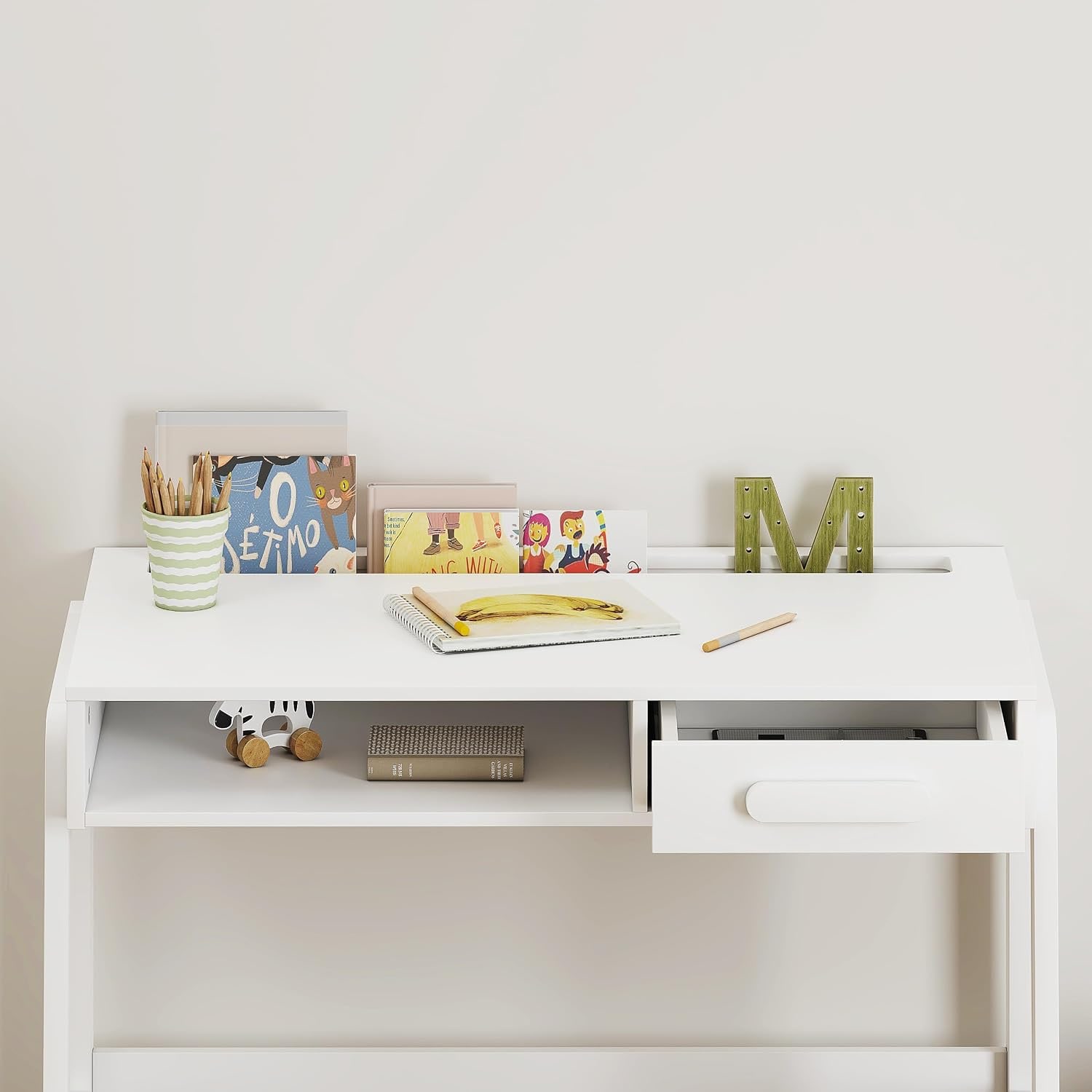
Storage comes in three forms. There is a tabletop organiser at the back of the desk for pens, pencils and rulers. There is an open storage cube beneath the desktop for books and folders a child reaches for constantly. And there is one pull-out utility drawer running on metal glides, for the things that should be out of sight.
The chair has a curved backrest and is included in the pack. The set seats one, and the maximum weight recommendation is listed at 110 pounds, roughly 50 kg.
Assembly is required. The maker recommends two people and a screwdriver, and the tools and instruction manual are included.
Three storage types, three different jobs
It is worth understanding why a desk like this has three separate storage spaces rather than one big one, because that is what separates a working study table from a nice-looking one.
The organiser handles the small, loose, rollable things. Pencils, pens, a ruler, a glue stick. These are the items that cause the most low-grade chaos because they scatter. Standing them upright at the back of the desk means they are visible and reachable without a hunt.
The open cube handles volume. Workbooks, readers, a folder, a sketchpad. Open storage works for daily items precisely because there is no door or drawer to open, so a child will actually use it. If something is used every day, hiding it behind a front is a losing battle.
The drawer handles everything else. Stickers, erasers, half-finished drawings, the bits that make a desktop look cluttered. Closed storage is where you put the things that are not needed right now. One drawer is enough for most primary-age kids, and metal glides mean it keeps sliding properly after a year of enthusiastic opening.
Who this size suits
Think about the surface, not the age. At 83.8 cm wide and 45 cm deep, there is comfortable room for an A4 workbook with a pencil case beside it, or a small laptop with space for a notebook. That covers most primary school homework, drawing and reading.
What it does not do is take two children working side by side. Only one chair is included and the listing confirms it seats one. If you need a shared surface, you want a wider table rather than a single-seat study desk.
The compact depth is the useful part for small rooms. A desk at 45 cm deep can sit under a window, in a corner, or against the short wall of a bedroom without dominating it. Leave about 60 cm of clear floor behind it so the chair can pull out and a child can get in and out without squeezing.
Getting the fit right
Buying a desk and a chair together removes most of the guesswork, which is why a children's desk and chair set is usually the easier purchase. The two pieces are designed to pair.
Still, check the fit once it is built. Sit your child at it. Their feet should rest flat on the floor, or on a footrest if they dangle. Their forearms should rest roughly level on the desktop rather than reaching up. Shoulders stay relaxed, not hunched towards the ears. If their feet swing, a box or a stack of old books under the feet is a two-minute fix.
Adjustable height is listed as a feature of this set. If that is your main reason for choosing it, check the manual that comes in the box for the exact adjustment range, since the listing records the same minimum and maximum figure of 28.3 inches.
Putting it together
Flat-pack assembly goes badly for predictable reasons, so handle them up front.
Clear a space bigger than you think you need, ideally on carpet or a blanket so panels do not get scratched. Open the hardware bag onto a plate or a tray, not the floor, because small screws disappear. Lay the panels out and match each one against the diagram before you pick up a screwdriver.
Leave every screw slightly loose until the frame is fully assembled and square. Then go back and tighten in order. This single habit prevents the wobble that makes people assume a desk is poorly made when it is just unevenly tightened.
The maker recommends two people. One to hold, one to drive. It is genuinely faster and the panels stay aligned.
Looking after it
Engineered wood with a painted finish is easy to live with, as long as you do not drown it. The care instructions are to wipe with a dry cloth, or a damp cloth for marks. Dry it straight after rather than letting water sit along an edge.
Skip the harsh solvents and the scouring pads. Both will dull a painted surface fast. For a child who paints, glues or works with clay, lay down a mat or an old tablecloth first. A desk mat costs very little and it is the single best thing you can do for the long-term look of a wooden kids desk.
Twice a year, go around with a screwdriver and check the leg screws, the frame joints and the chair fixings. Flat-pack furniture settles after a few weeks of real use. Five minutes of tightening keeps the whole thing feeling solid for years.
Setting it up in the room
Light matters more than most people expect. Side light beats light coming from straight ahead, which creates glare, and beats light from directly behind, which puts a shadow on the page. If you are right-handed, light from the left is easier.
Try to keep the desk away from the bed. Not because of any rule, but because a desk in arm's reach of a pillow tends to become a shelf. If you have the option, a corner near a power point is a sensible long-term pick, since a child who uses this desk for paper now will probably want a device on it later.
And keep the space clear. The whole point of a desk with an organiser, a cube and a drawer is that nothing needs to live loose on the desktop.
The short version
This is a practical, compact study desk and chair set, sold as two items, with three distinct storage spaces and a wipe-clean painted surface on metal legs. It measures 45 by 83.8 by 59.7 cm, holds up to 110 pounds, seats one, and needs assembly with two people and a screwdriver.
Measure your space first. Check your child's fit once it is built. Put a mat down if craft is on the agenda. Do those three things and you have a homework spot that actually stays tidy, and a kitchen table you can eat at again.