
The complete guide
Choosing a Kids Tool Bench That Does Not End Up in Pieces Under the Couch
The problem with most toy tool sets
Ask any parent who has bought one. The tool set arrives, it is a hit for about a fortnight, and then the hammer is in the toy box, two spanners are behind the bed, the plastic screws have vanished entirely, and what is left is a bench with nothing to build with. Nobody threw anything away. The pieces just drifted.
That is not a child problem. It is a storage problem. A pretend play tool kit has a lot of small parts by design, because the whole point is screwing things together and taking them apart again. If the set does not come with somewhere obvious for those parts to live, they will not live anywhere.
This is the gap a convertible kids tool bench fills. Instead of a bench plus a separate bag you have to remember, the bench itself is the container. You build it up to play, you pull it down to pack, and the tools go in the tray. One object in, one object out.
How the 2-in-1 design actually works
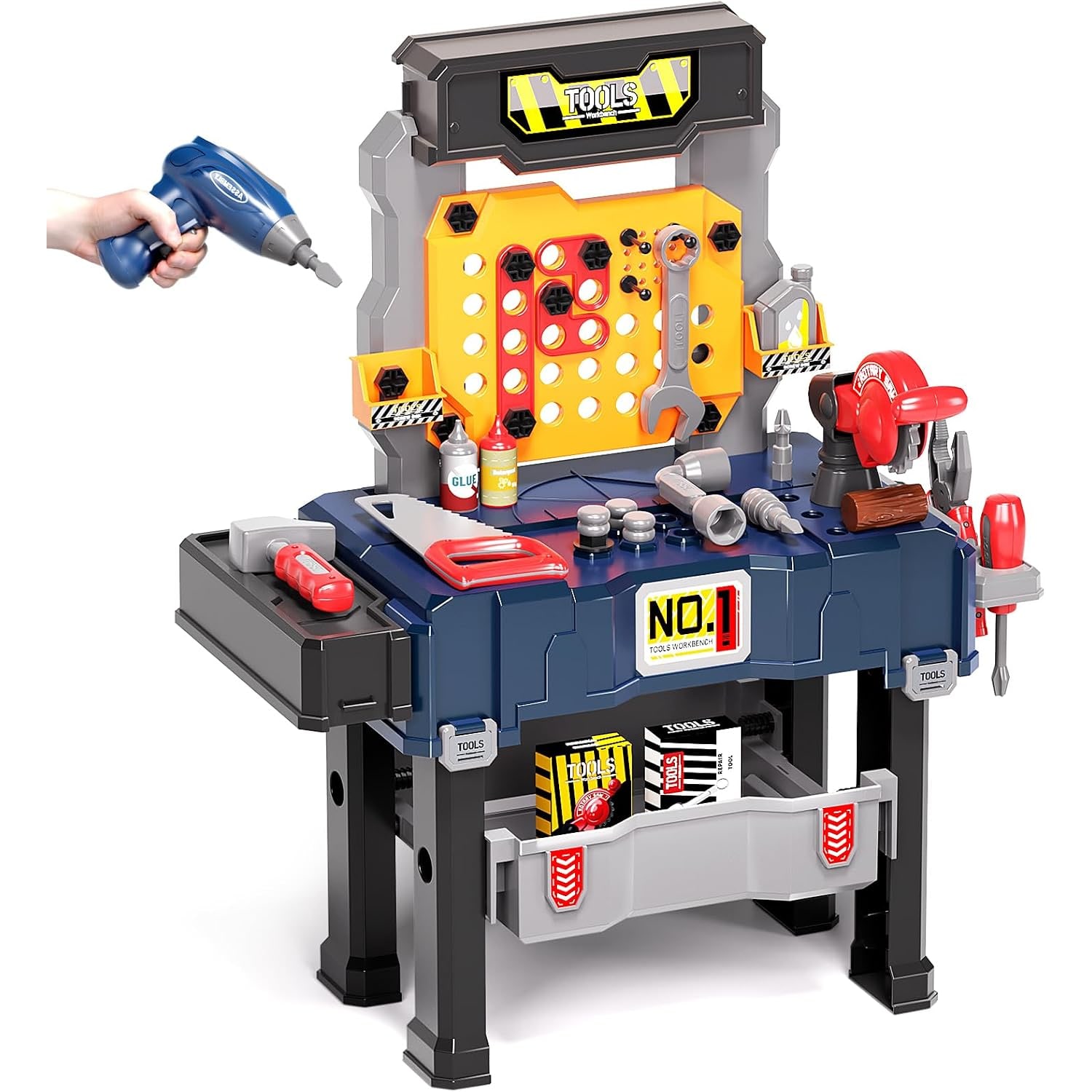
The set starts as a case. Open it, assemble the parts, and you have a work station with a flat bench surface and a deep tray sitting underneath. The tray is the clever bit, because it is sized to take the entire kit rather than a token handful of pieces.
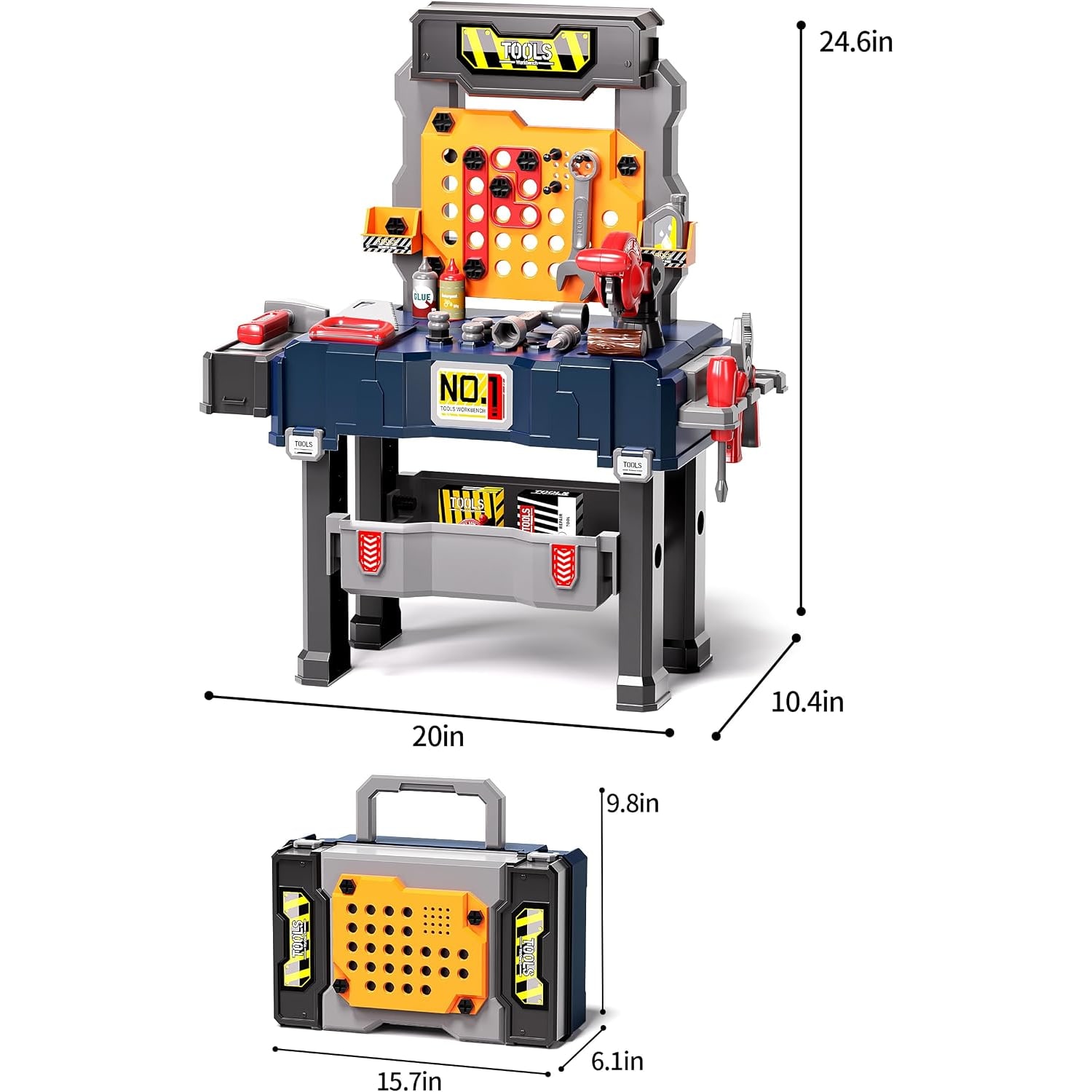
When play is over, the process runs backwards. Bench comes apart, tools go in the tray, case closes. Packed down, the whole thing measures 39.9 x 26.5 x 15.5 cm and weighs 1.76 kg, which is roughly the size and heft of a small school backpack. A child of five can carry it by the handle without drama.
That portability changes where the toy gets used. A fixed workbench lives in one corner of one room forever. A case travels to the kitchen table while you cook, out to the back deck on a good afternoon, into the car for a long drive, round to a cousin's place on a Sunday. Parents searching for the best portable kids workbench are usually chasing exactly this, and the case format is the reason it works.
What is in the box
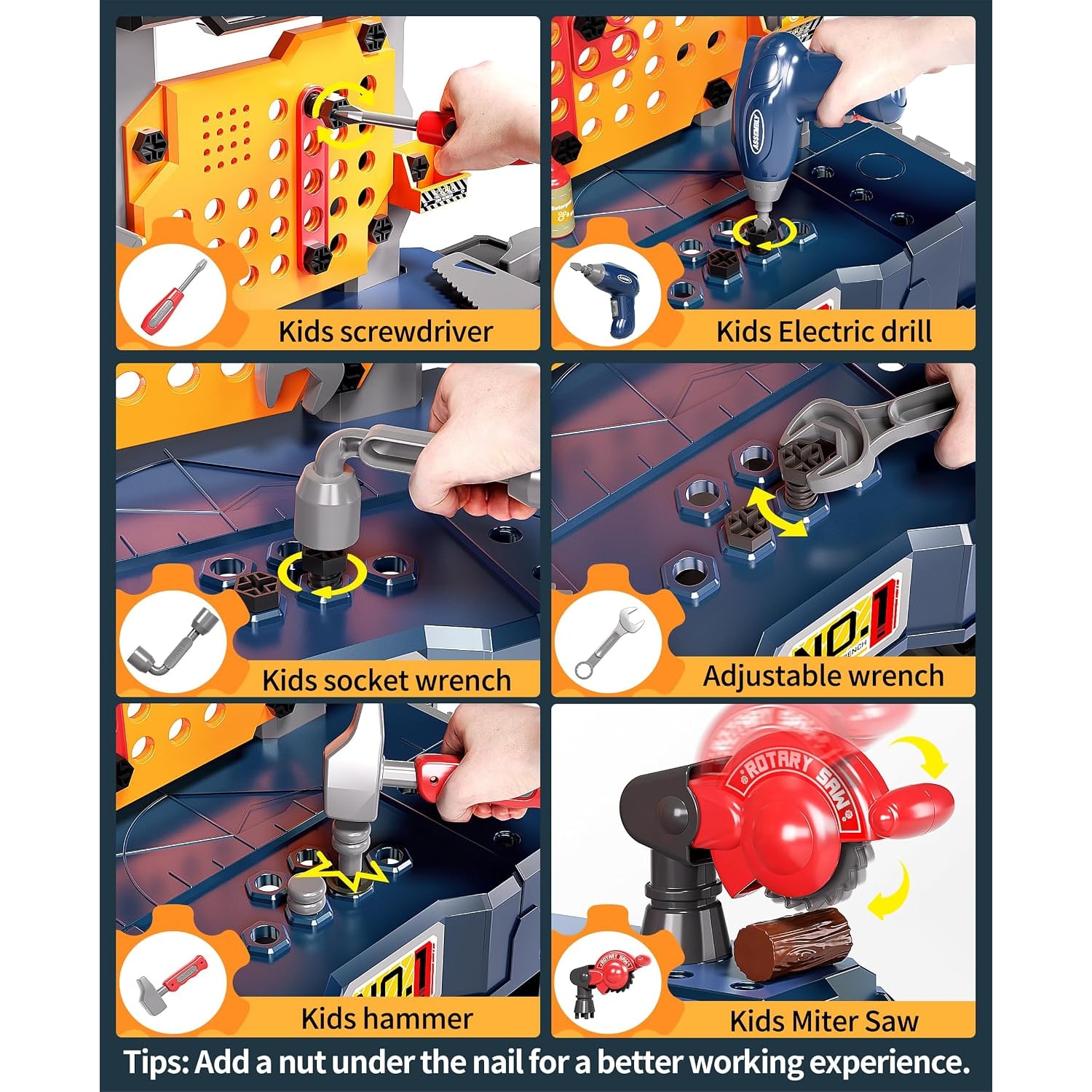
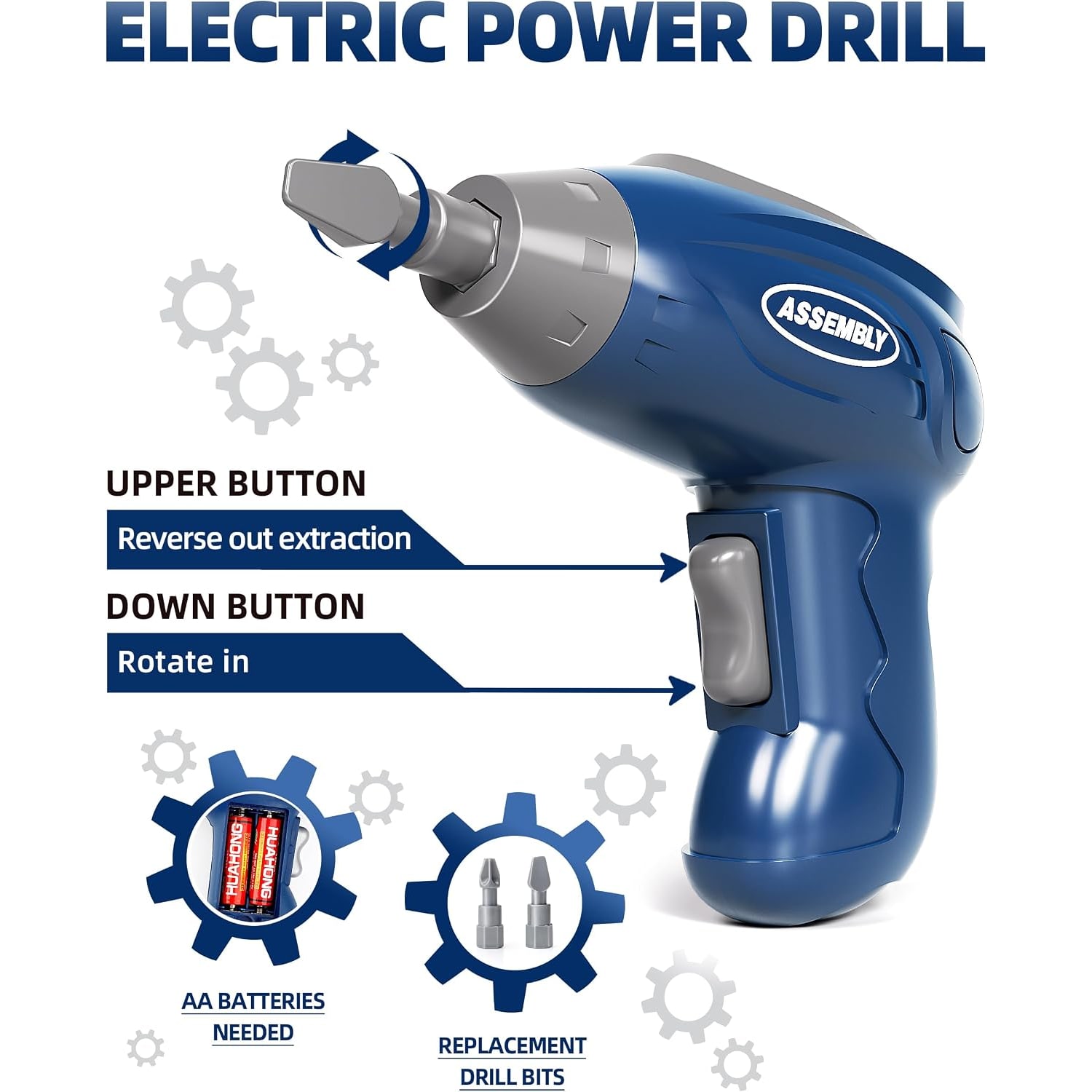
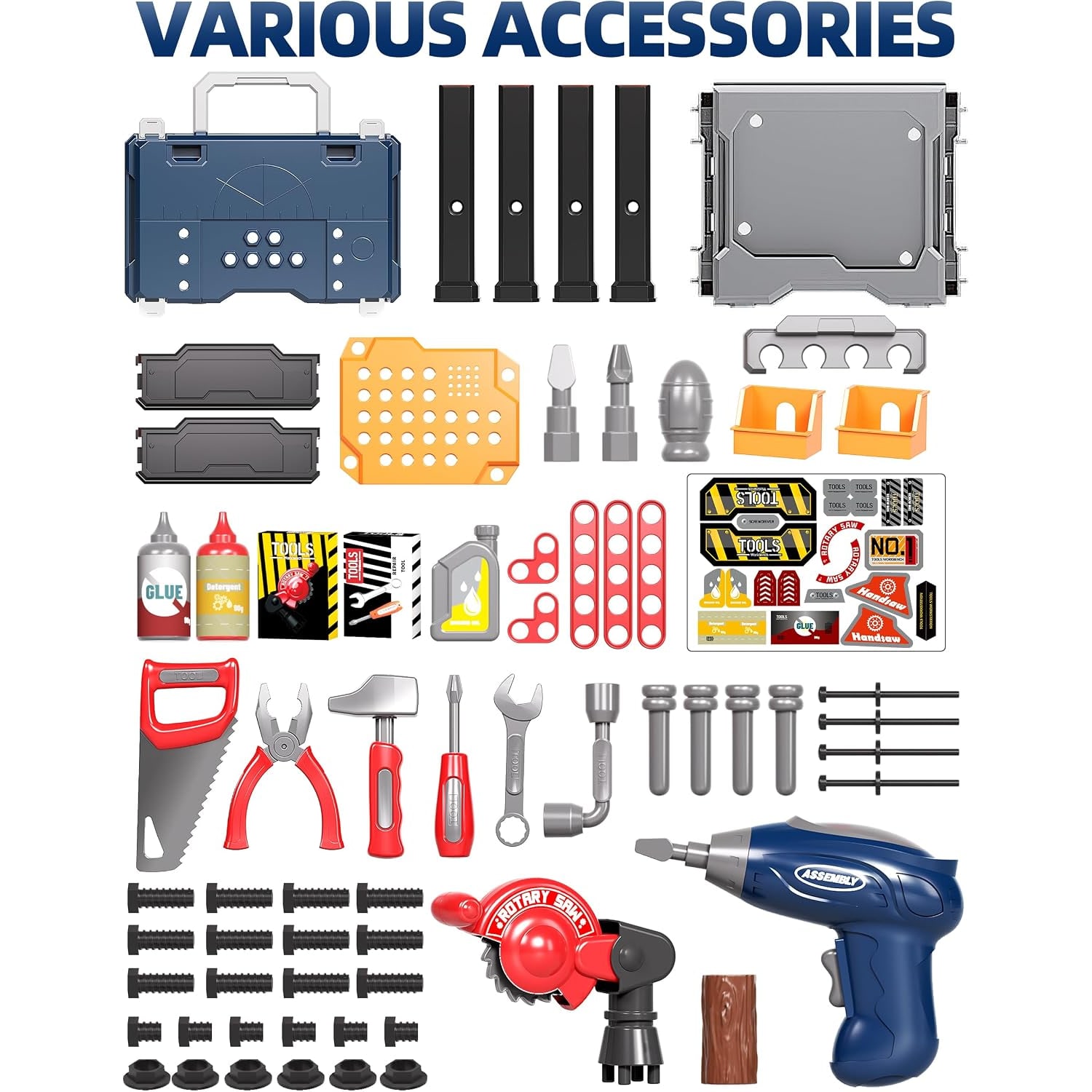
The tool list is broader than a lot of starter sets. There is a manual power drill with a set of interchangeable heads, so your child can swap bits the way an adult would. There is a mechanical miter saw with a working hand movement. There is a screwdriver with matching screws, plus nuts and bolts for assembly work.
On the hand tool side you get a claw hammer, a selection of spanners in different sizes, a pair of pliers and a hand saw, along with other smaller play tools. Everything is moulded in ABS plastic and everything is manually operated. The power source is listed as manual, full stop.
That last point is worth sitting with. No batteries means the toy works the moment you open it and keeps working in two years. There is no flat AA at seven in the morning, no screwdriver hunt to get at a battery compartment, no slow fade as the motor loses enthusiasm. For a lot of households, a battery-free set is the best toy workbench with drill option simply because it never stops being available.
Colour, brand and country of origin are not specified, so we are not going to guess at them.
Who it suits
This is a set for ages 3 and up. It contains small parts, including screws, nuts and bolts, so it is not suitable for children under 3.
Within that range, it tends to land differently at different ages. A three or four year old is mostly interested in the actions: turning the drill, swinging the hammer, loading the tray and emptying it again. The joy is in the handling. Older children start building sequences, where a bolt goes through a hole, a nut goes on the back, and the spanner tightens it. At that point the set stops being a prop collection and starts being a system.
The number of players is listed as one, which is honest. The bench has a single work surface, so siblings will take turns rather than build side by side. If you have two children who want to work together, plan for sharing or consider a second set.
It also suits households that are tight on space. A permanent play station is a commitment. A case that goes on a shelf is not.
How to choose between tool benches
A few things separate the ones that last from the ones that disappoint.
Storage comes first. Ask where the pieces go when play stops. A deep tray built into the bench, like this one has, beats a loose bag every time, because nobody has to remember the bag.
Then look at the tool list. A set with a drill, a saw, a hammer, spanners and pliers covers most of what a child imagines a workshop to be. A set with three tools and a lot of plastic bench runs out of ideas fast. The presence of real fasteners, meaning screws, nuts and bolts that actually fit the tools, is what makes a kit the best kids tool box set rather than a shelf of props.
Check the power source. Motorised drills are fun for a week and then they are a battery liability. Manual mechanisms keep working.
Think about footprint, both set up and packed down. Measure the shelf you intend to use before you buy. This set is 39.9 x 26.5 x 15.5 cm packed, so a standard bookshelf shelf takes it comfortably.
Finally, consider assembly. This set requires assembly before first use. That is a one-off job for an adult, and after it is done, taking the bench apart and rebuilding it becomes part of the play rather than a chore.
Looking after it
Plastic toys last a long time if you treat them sensibly. Wipe the bench and the tools with a damp cloth and a little mild soap when they get grubby, then dry everything before you pack the case. Trapped moisture in a closed box is the main cause of musty toys.
Keep the set out of long stretches of direct sunlight and away from heaters. Plastic warps with heat, and a warped bench will not clip back together properly. Never put any part in a dishwasher, a washing machine or an oven.
Run a quick check over the fittings now and then. If a clip has gone soft or a piece has cracked, take it out of the set. Cracked plastic can leave an edge you would rather your child did not find.
For the small parts, build a habit rather than a rule. One sweep of the bench into the tray at the end of each session does more for part retention than any amount of reminding. Children who want the best pretend play tools in the house usually figure out quickly that keeping the pieces together is what makes the game work.
Delivery and returns
We ship from Australian warehouses, and delivery normally runs 3 to 7 working days. Tracking goes out as soon as the parcel leaves. Returns are open for 14 days from delivery, with the set unused and back in its original packaging with all pieces present.
If you are storing it for a later date, open the carton and check the contents on arrival anyway. It is much easier to sort a missing piece in week one than in week six, and the return window runs from delivery, not from the day you open it.
The short version
A kids tool bench is only as good as its storage, and this one solves that by being its own box. You get a manual drill with swappable heads, a mechanical miter saw, a screwdriver with screws, nuts and bolts, a claw hammer, spanners, pliers and a hand saw, all in ABS plastic, all battery-free, all fitting into a deep tray under the bench.
It packs down to 39.9 x 26.5 x 15.5 cm, weighs 1.76 kg, needs assembly before the first play, and is built for one player at a time. Recommended for ages 3 and up, and not for children under 3 because of the small parts.
If you want a workshop your child can carry to wherever you happen to be, and put away in one go afterwards, this is the shape that works.