
The complete guide
How to Choose a Height Adjustable Kids Table and Chair Set
The problem with children's furniture
Most kids' tables are bought for one moment. A three year old needs somewhere to draw, so you buy a small set, and for about eighteen months it is perfect. Then one day you look over and their knees are pressed against the underside, their shoulders are hunched, and the chair that once swallowed them now looks like a stool. The set goes to the garage or the verge, and you buy another one.
That cycle is expensive and it is wasteful. It also means there is often a gap, a stretch of months where the old set is too small and the new one has not been bought yet, and the kitchen bench becomes the craft table by default. Anyone who has scraped dried glue off a benchtop knows how that goes.
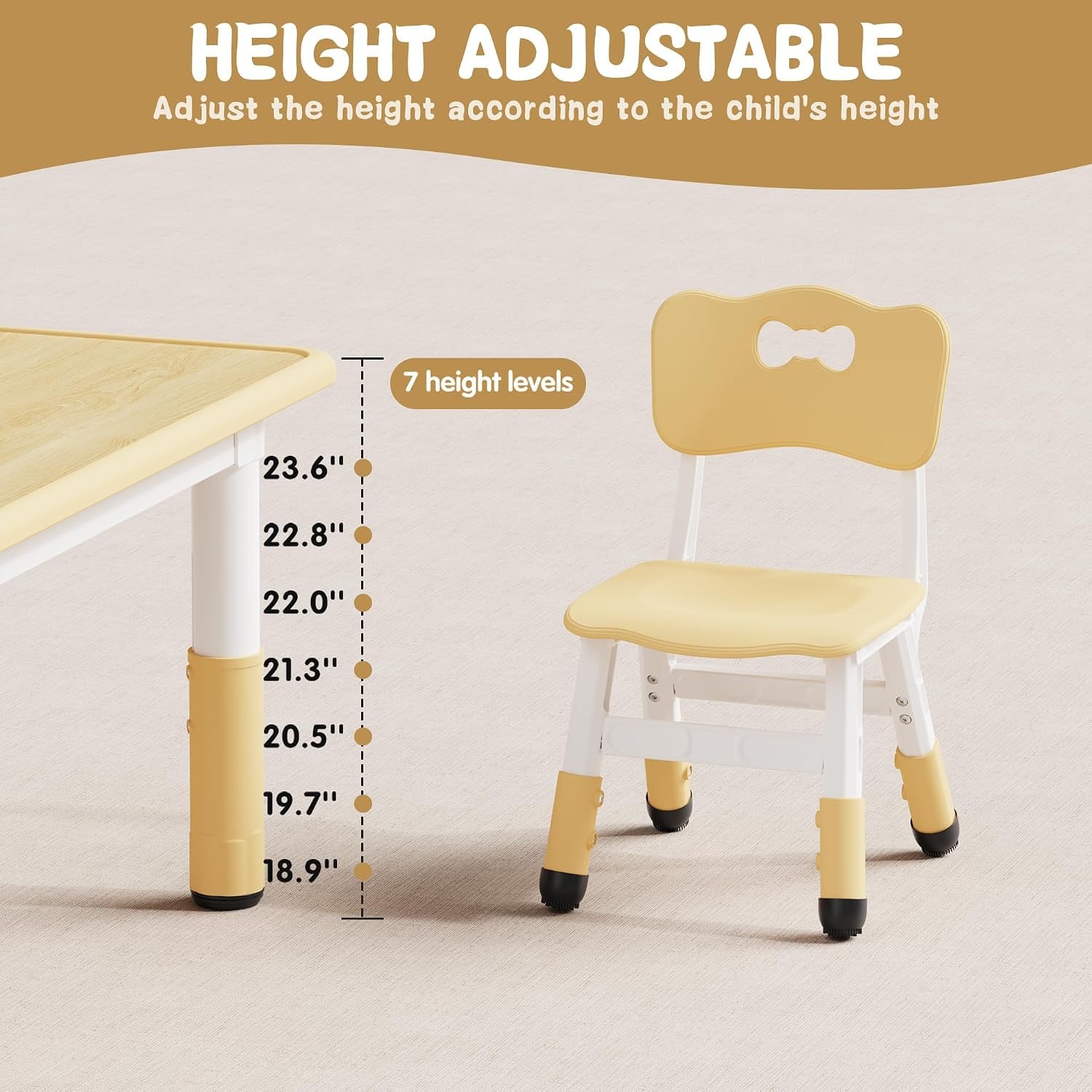
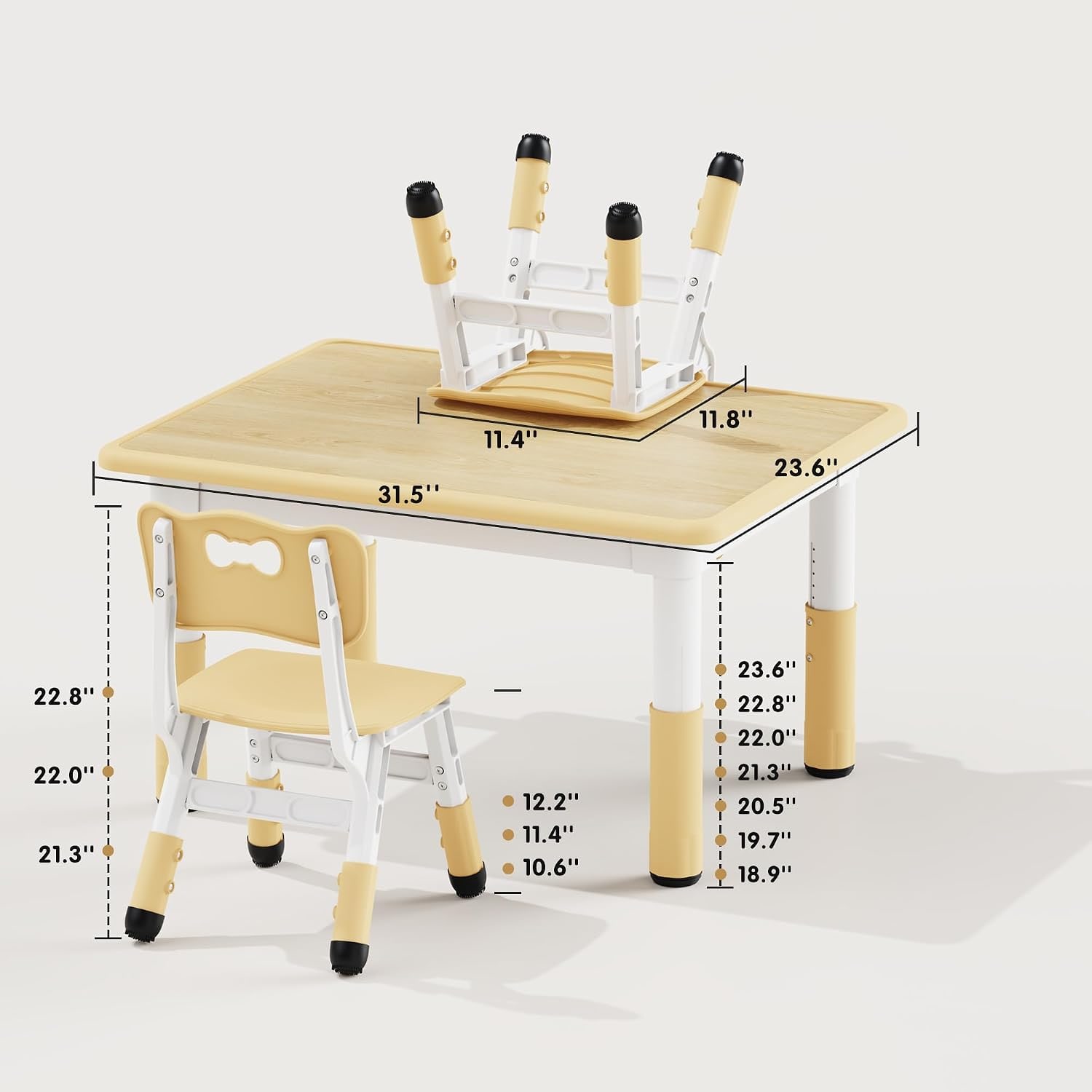
A height adjustable set sidesteps the whole thing. Instead of a fixed leg length chosen for one stage, the legs move. This one gives seven settings on the table and three on each chair, which means you are not picking a size, you are picking a range.
How the adjustment actually works
The mechanism is deliberately simple. The legs attach to the table and chairs with fittings that can sit at different positions, and moving a level means loosening the fixing, repositioning the leg, and tightening it again. There is no gas lift, no lever, no spring. Nothing to wear out or jam.
The upside of that simplicity is reliability. The downside is that it is not a thirty second job you do on a whim. You will want a screwdriver and a few minutes of peace. In practice that is fine, because you only change the height once or twice a year as a child grows.
One tip worth repeating: keep the instruction sheet and any spare fittings in a labelled bag taped under the table top. Two years from now, when you need to move up a level, you will be very glad you did.
Stability matters more than you think
Children do not sit on chairs the way adults do. They kneel on them, they lean back, they swing their legs, they climb off sideways while holding a cup of water. A chair that is merely adequate under a still load can feel wobbly under all of that.
This set addresses it in two places. Each chair has two cross bars running between the legs, which is the part that stops a four-legged frame from racking, that slight parallelogram wobble you get in cheap seating. And the feet carry rubber pads, which do two jobs at once. They grip, so the chair does not shoot backwards on tile or timber when a child pushes off, and they soften the scrape that otherwise travels through the whole house.
The table gets similar treatment. Rather than relying on a single joint where each leg meets the top, there are two screws at the base of each corner, forming a triangular brace. It is a basic engineering idea. Triangles hold their shape under twisting force in a way that squares do not. The maker lists the table as holding up to 130 kg and each chair up to 80 kg, which is static load rather than an invitation to stand on anything.
Why the shape of the top matters
The table is rectangular, 80 cm along its longest dimension. Compared with a small round or square table taking up the same room, a rectangle gives you more genuinely usable surface, because the corners are where things end up. Paint pots, a stack of paper, a cup of pencils, a half-built construction set.
It also changes how two children sit. On a round table they are always at an angle to each other. On a rectangle they can face off across the width, which works for board games and shared drawing, or sit side by side along one edge, which works when they are both looking at the same book or the same project. Small thing, but it comes up daily.
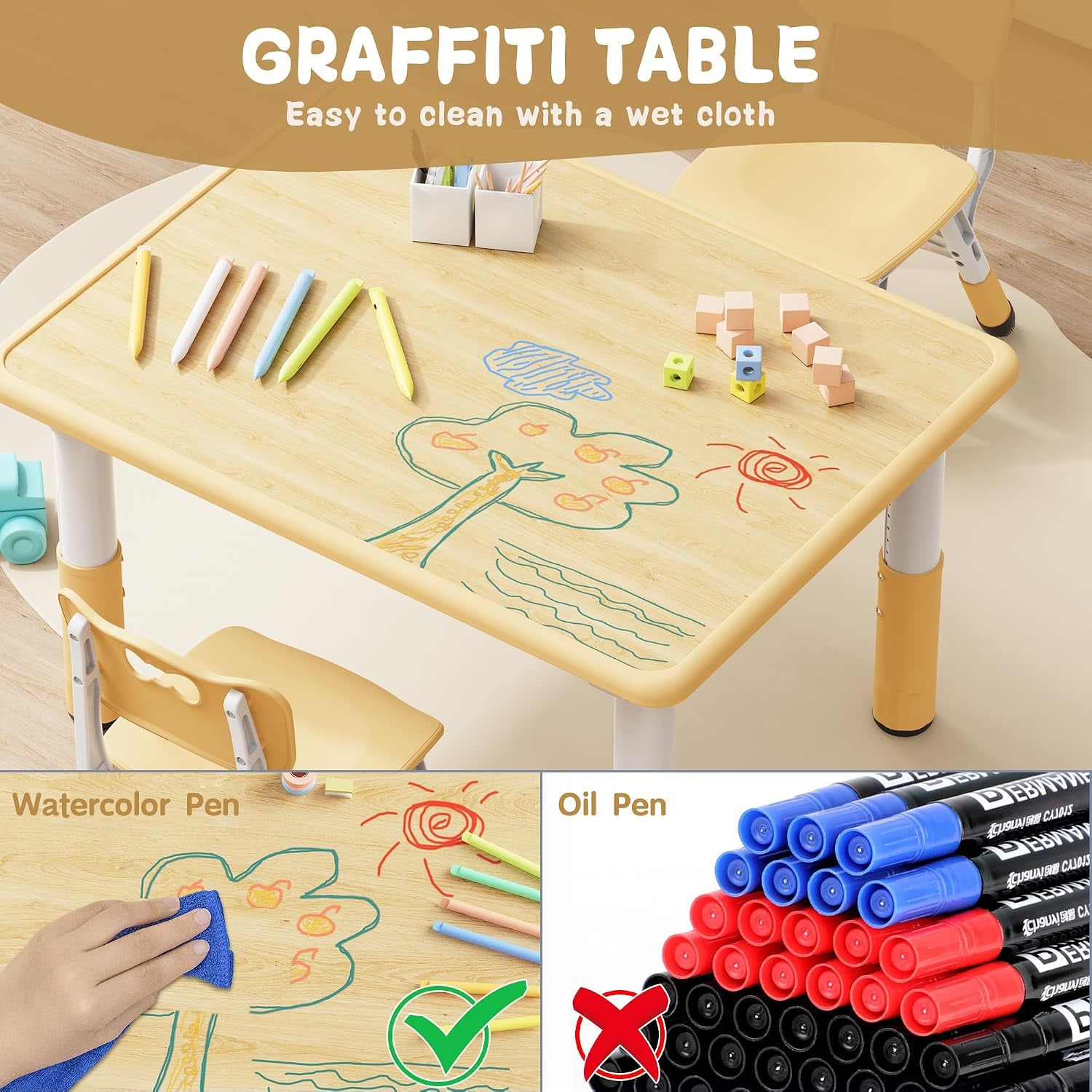
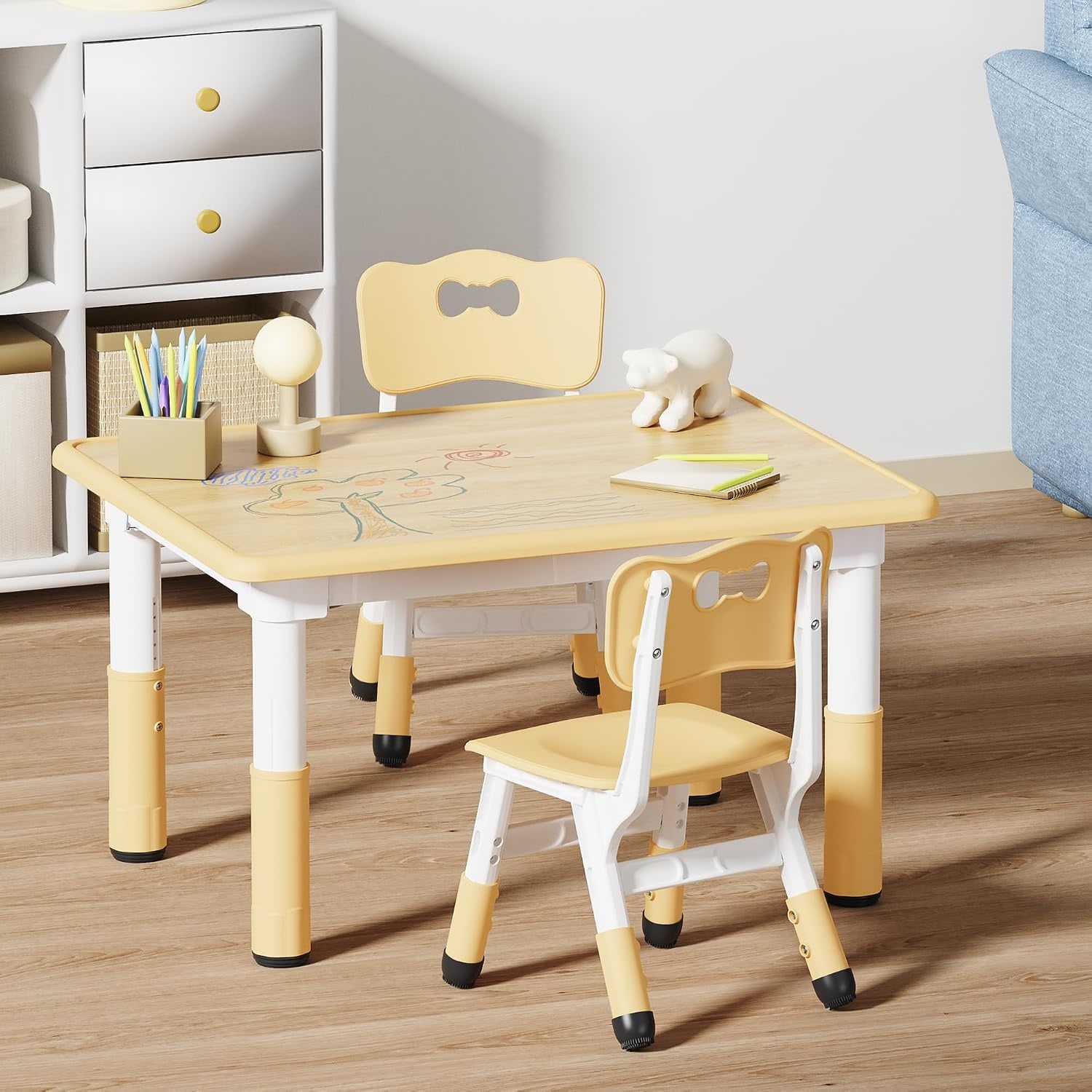
The top itself is smooth and designed to be wiped down. Watercolour pencil comes off with a damp cloth, which is the main reason a set like this ends up being the craft table rather than just the snack table. The finish is beige and the style is listed as modern, which is a polite way of saying it will not fight with your living room.
Who this suits
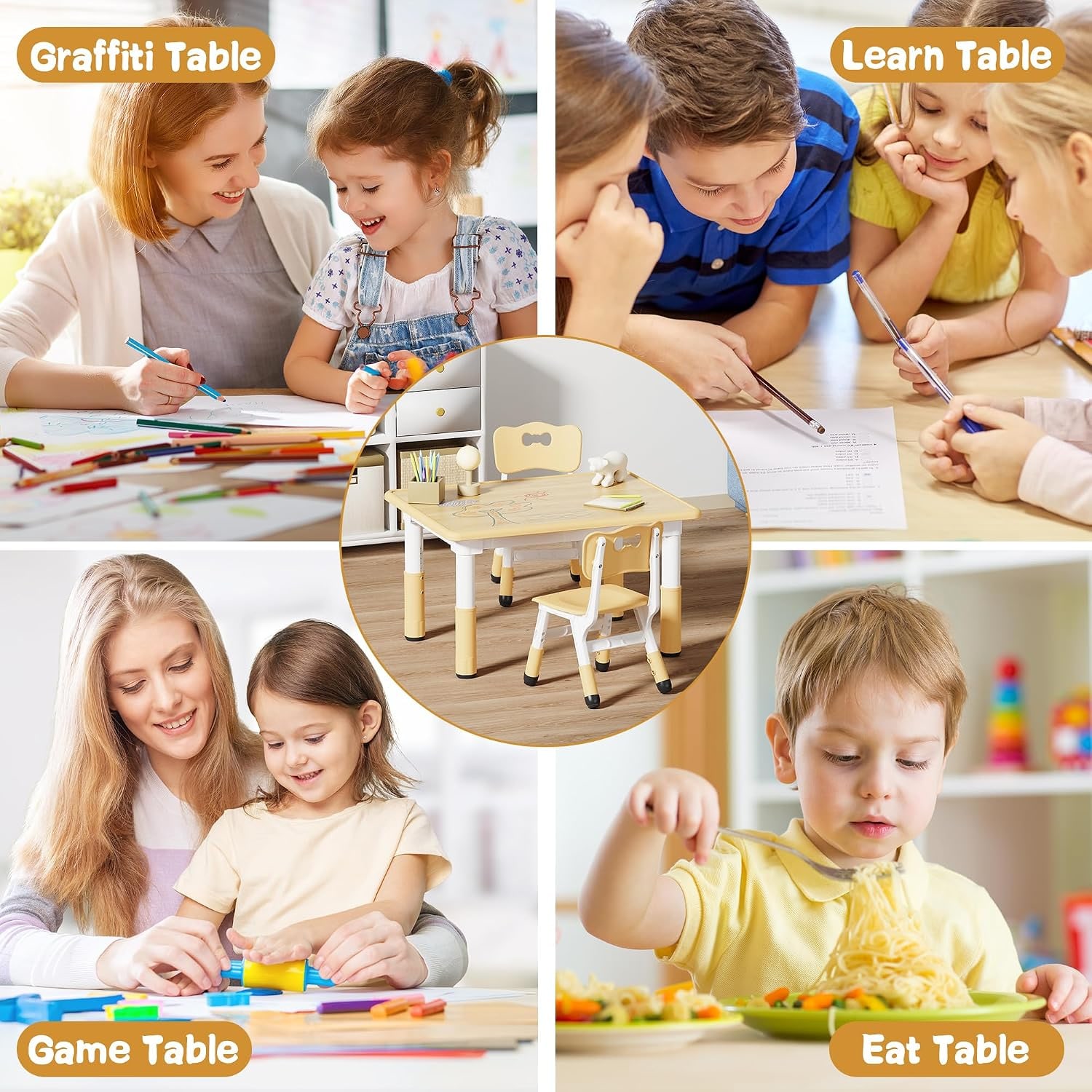
It suits households where one piece of furniture has to do several jobs. Breakfast, drawing, puzzles, homework, playdough, the lot. The adjustability is most valuable to parents of a child right at the start of the useful range, because that is where you get the most years out of it.
It suits homes with two children close in age, since two chairs are included and the rectangular top handles a pair comfortably. If your children are further apart in age, the chair adjustment lets you set the two seats differently, though they will both share the one table height.
It also works in classroom and daycare settings for the same reason, where children of different heights cycle through the same furniture across a week. Being able to drop the table a level for a younger group and raise it again afterwards is genuinely useful.
Where it is less of a fit: if you need something that folds away between uses, this is not that. It assembles into a permanent piece. And if you want a set with built-in storage bins or a sunken play tray, this is a flat-top table and that is all it tries to be.
Getting the height right
Start with the child, not the table. Sit them on a dining chair with their feet flat on the floor and their back against the backrest. Measure from the floor to the back of the knee, that is your target seat height. Then measure from the seat to the elbow, with the upper arm hanging straight down and the forearm level. Add a small amount to that figure and you have your target table height.
Set the chair first, then set the table to match. Once they are sitting, check three things. Are the feet flat on the floor or on a footrest, not dangling? Are the forearms resting on the table without the shoulders rising? Is there clear space for the knees underneath? If any of those is off, move one level and check again.
Expect to revisit this roughly once a year, or whenever you notice shoes getting replaced faster than usual. Growing happens in bursts.
Care and keeping it solid
Cleaning is simple. Damp cloth, dry off the water, done. Skip the abrasive pads and the strong solvents, since both can dull a smooth surface permanently. For dried paint or glue, lay a damp cloth over the spot for a minute to soften it rather than attacking it with a scourer.
The more important bit of maintenance is the hardware. Any assembled furniture that gets daily use from children will work its fittings loose eventually. Put a reminder in your phone for every few months, go around the leg screws and chair fittings with a screwdriver, and nip up anything that has moved. It takes a minute and it is the difference between a set that lasts years and one that develops a wobble you learn to live with.
Keep it indoors. Short spells on a covered verandah are not a problem, but rain and long hours of direct sun are not kind to any furniture of this type.
The short version
You are buying range, not a size. Seven table heights and three chair heights mean the set adapts instead of being outgrown, and that is the whole argument for spending more than you would on a basic fixed set.
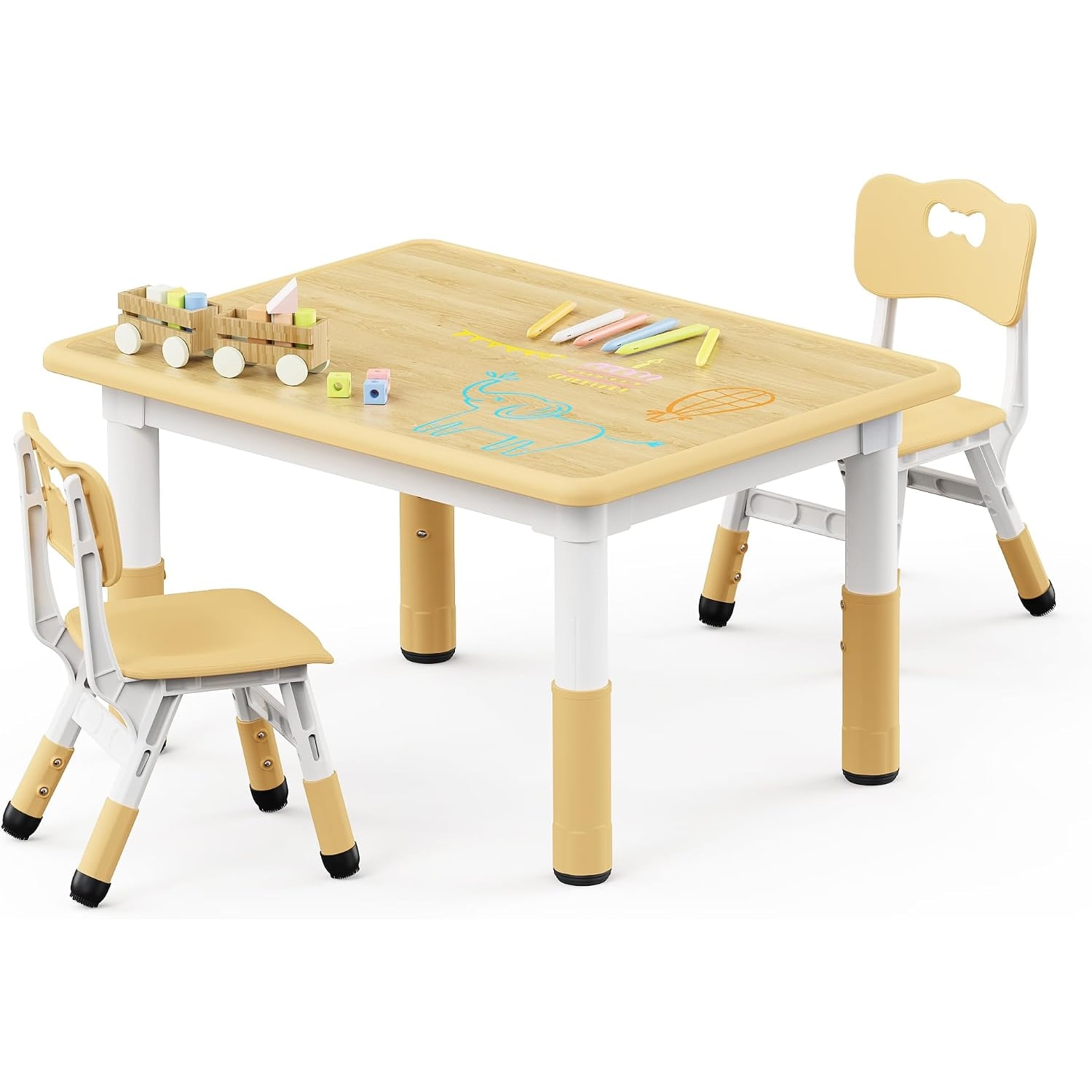
Three pieces arrive in one box, a rectangular table measuring 80 x 60 x 60 cm overall with two chairs. Cross bars and rubber pads handle the wobble. The smooth top handles the mess. Assembly is required and the instructions are in the box, which is a one-off hour that pays for itself over the following years.
Suitable for ages 3 and up. Measure your child before you pick a starting height, keep the hardware somewhere you will find it again, and check the screws now and then. Do those three things and this is a piece of furniture that quietly earns its keep.