
The complete guide
How to Choose a Desk Globe That Actually Gets Used
The problem with flat maps
Most of us learned the world from a rectangle. A wall map, an atlas page, a screen. Rectangles are convenient, and they are also a lie about shape. Greenland balloons until it looks like Africa. Antarctica smears into a white strip along the bottom. Russia stretches across the top like a dropped ribbon. Nobody intends this. It is just what happens when you peel a sphere and flatten it.
The cost shows up in small, quiet ways. You read that a flight goes from London to Tokyo over the Arctic and it makes no sense, because on your mental rectangle that route is a detour. You hear two countries described as neighbours and cannot picture it. You know where Chile is and you know where New Zealand is, and you have no feel at all for how much ocean sits between them.
A globe fixes this without trying. You spin it, you look, and the proportions are simply correct because the surface is the right shape. That is the whole argument. A 20cm world globe on a desk solves a problem that a much larger map on a wall never quite does, because the wall map is fixed and this one turns.
What a political map shows you
Globes come in two broad flavours. Physical maps colour the world by terrain, so you get green lowlands, brown highlands and ocean depth in shades of blue. Political maps colour the world by country, with borders drawn, capital cities marked and major cities labelled.
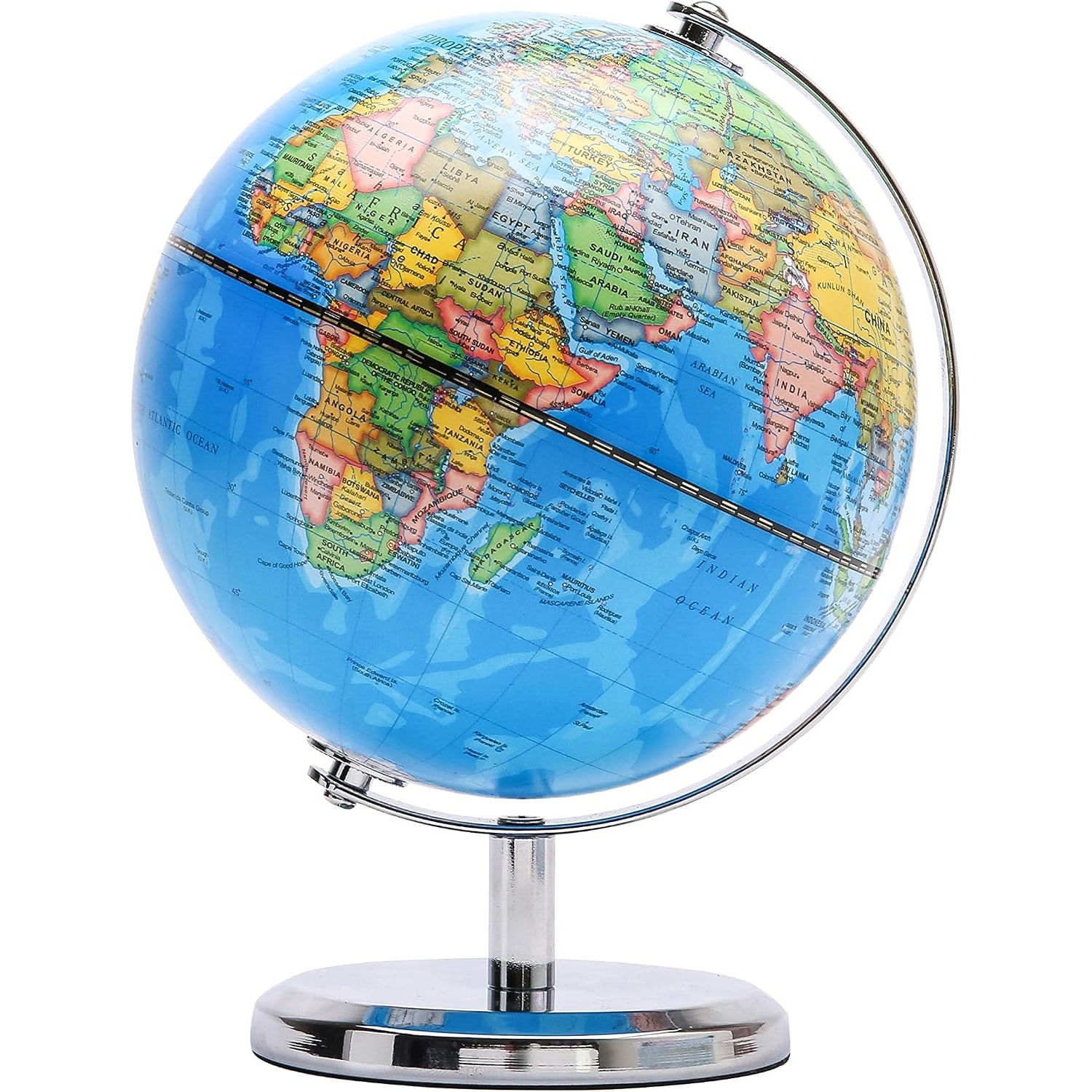
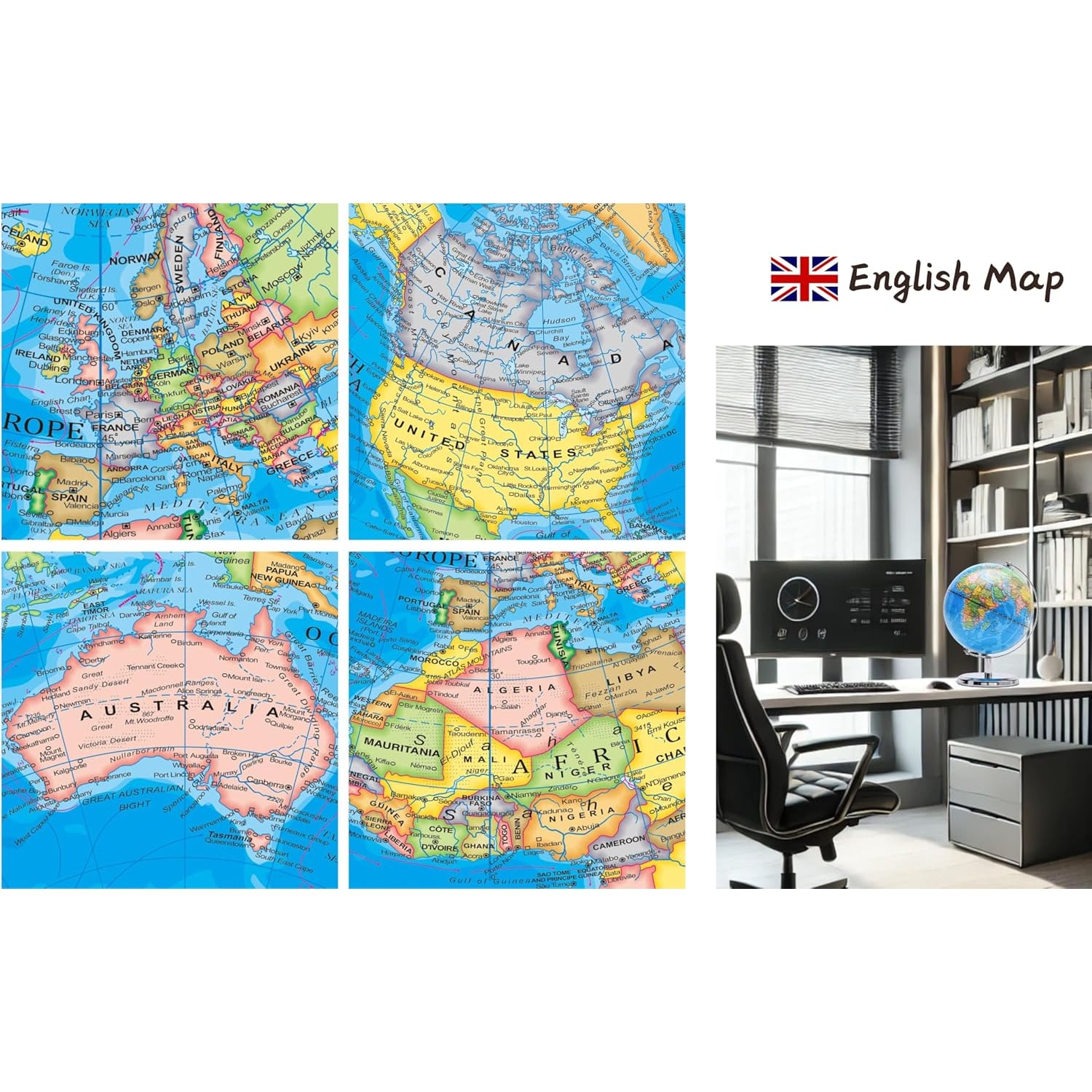
This one is a political map globe. It shows countries, political boundaries, capital cities and major cities, printed finely enough to read clearly rather than guess at.
Which one you want depends on the questions you ask. If your interest is mountain ranges, river systems and why deserts sit where they do, you want physical. If your interest is news, history, travel, trade and the simple business of knowing which country is which, you want political. Most households ask the second kind of question far more often, which is why the best political globe for general home use tends to be the one that gets picked up.
Political maps do carry one caveat worth stating plainly. Countries change. Names change, borders shift, capitals occasionally move. Any printed globe reflects the world as it was when the map was made. The specific edition date for this map is not listed in the maker details, so treat it as a strong general reference rather than an authority on the newest border dispute.
Why 20 centimetres is the practical size
Globe sizing is one of those decisions people regret in both directions.
Go too small, and you get a lovely object that cannot do the job. On a 10 or 12 centimetre sphere, Europe is a crowded smudge and anything smaller than Belgium has no room for a label. It looks good. It answers nothing.
Go too large, and the globe stops being furniture and starts being a commitment. A 30 or 40 centimetre floor globe reads beautifully, and it also needs its own patch of floor, its own sightline, and a room arranged partly around it. Plenty of homes do not have that patch.
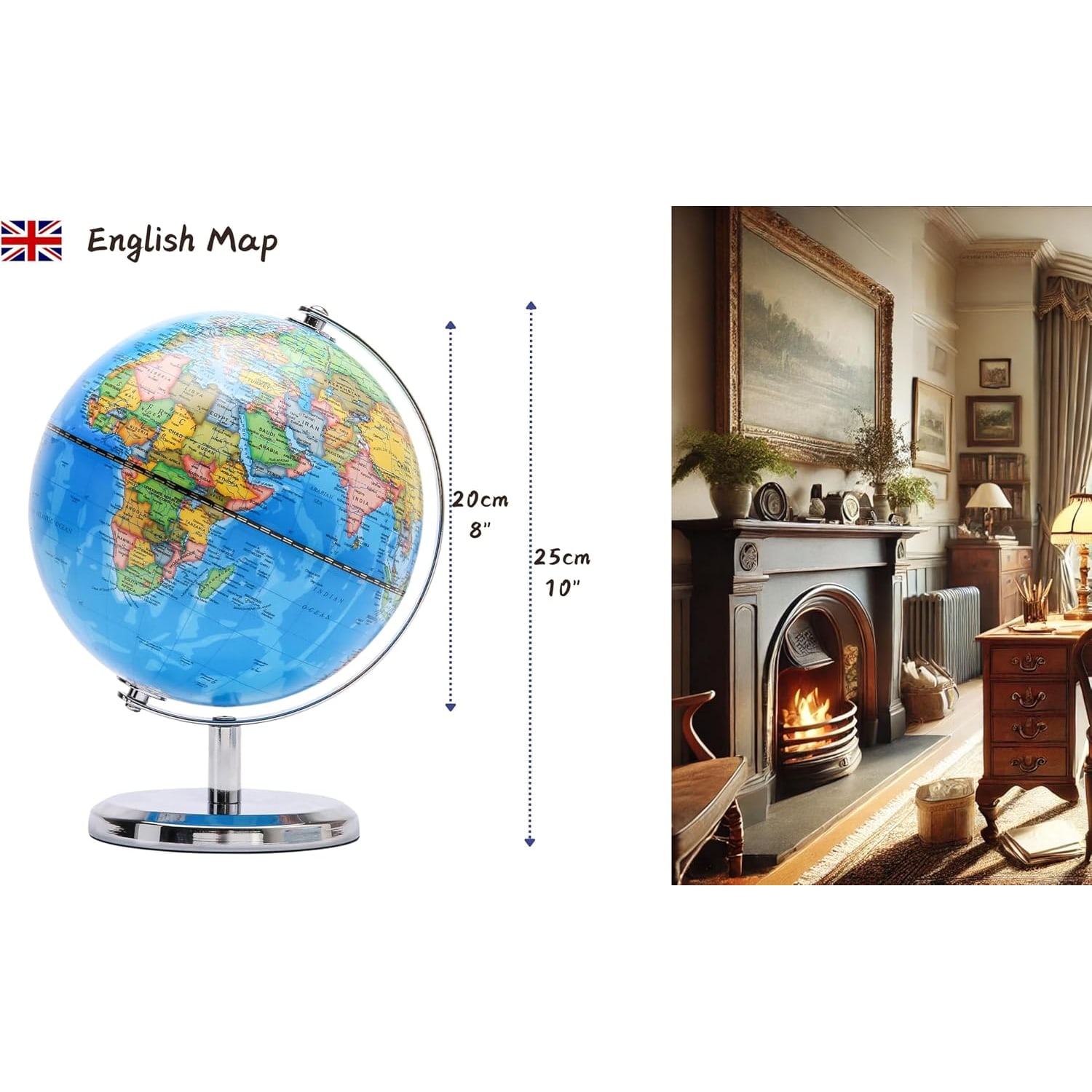
Twenty centimetres is the useful middle. It is large enough that continents have real presence and city labels are legible at normal desk distance. It is small enough to live beside a laptop, between upright books on a shelf, or on the corner of a kitchen bench. People searching for the best 20cm globe are usually circling this exact compromise without having named it yet.
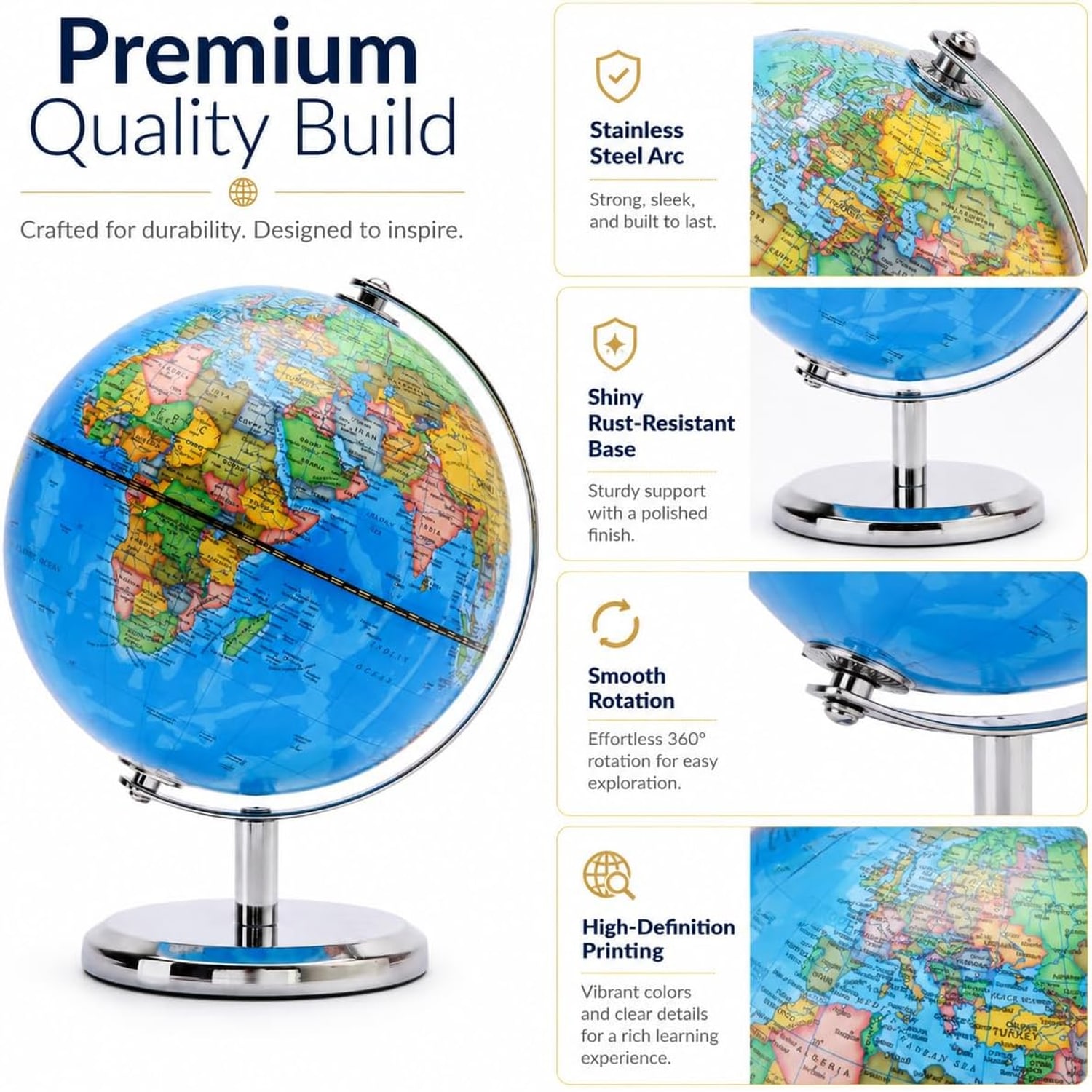
The 1.15 kilogram weight is part of the same logic. Light globes feel cheap and worse, they move. Spin a light one and it drifts across the desk. The steel arc and base here give this piece enough mass to hold position while the sphere turns under your hand.
The stand matters more than you think
The arc and base on this globe are polished stainless steel. That choice does two things.
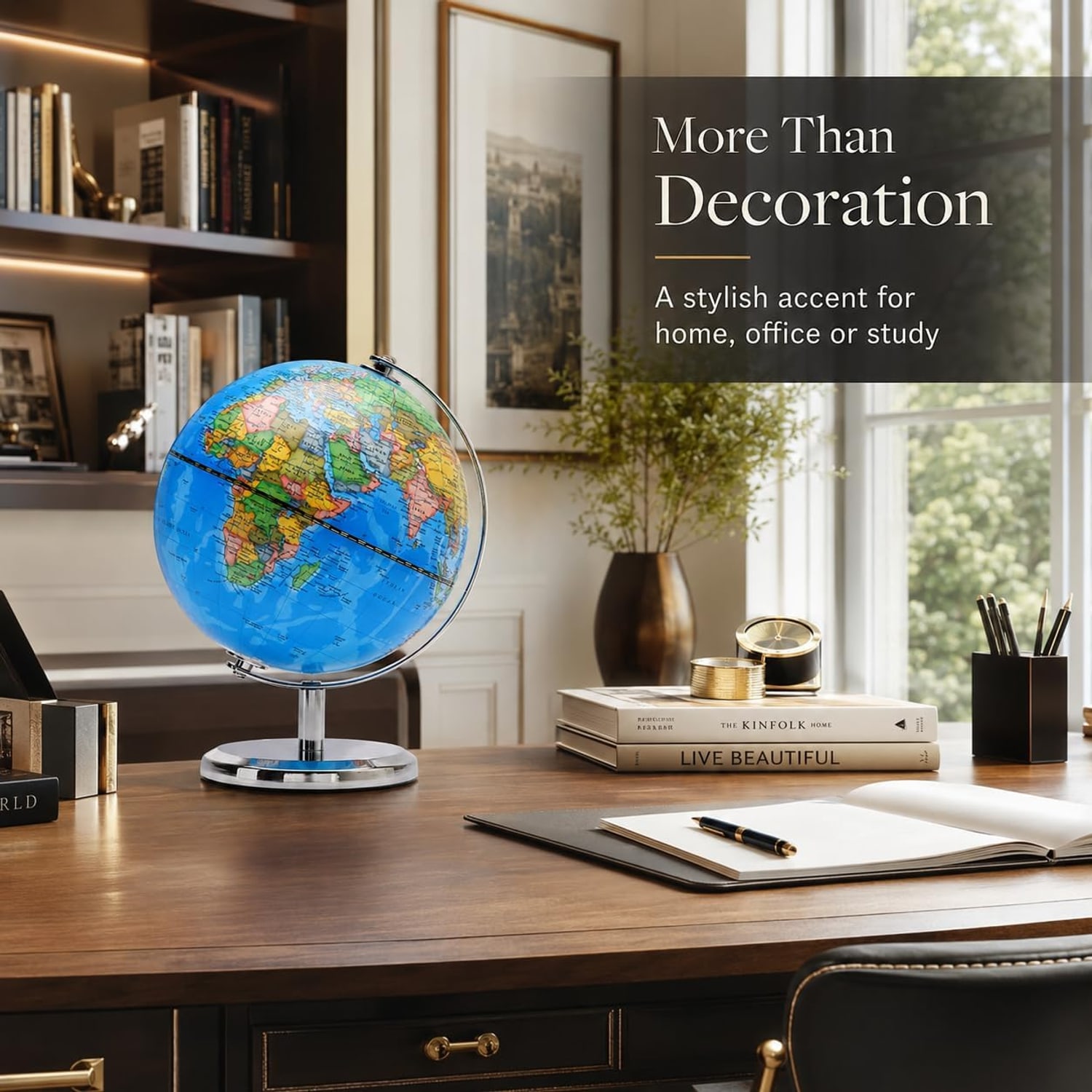
First, it changes how the piece reads in a room. Moulded plastic cradles and dark stained timber both push a globe towards a particular look, either school supply or old study. Polished steel is quieter and more neutral. It sits comfortably on a modern desk, in a home office with metal lamps, or on a shelf of plain books without announcing a theme.
Second, it changes how it behaves. Steel is dense, so the weight sits low. That is what keeps the globe planted when a child gives it an enthusiastic spin. Anyone comparing options for the best globe with metal base is really comparing stability, and mass in the base is how you get it.
One practical note. Check the underside before you set it on a polished timber desk. If there is no soft pad, a felt disc or a small coaster underneath prevents marks.
Who it suits
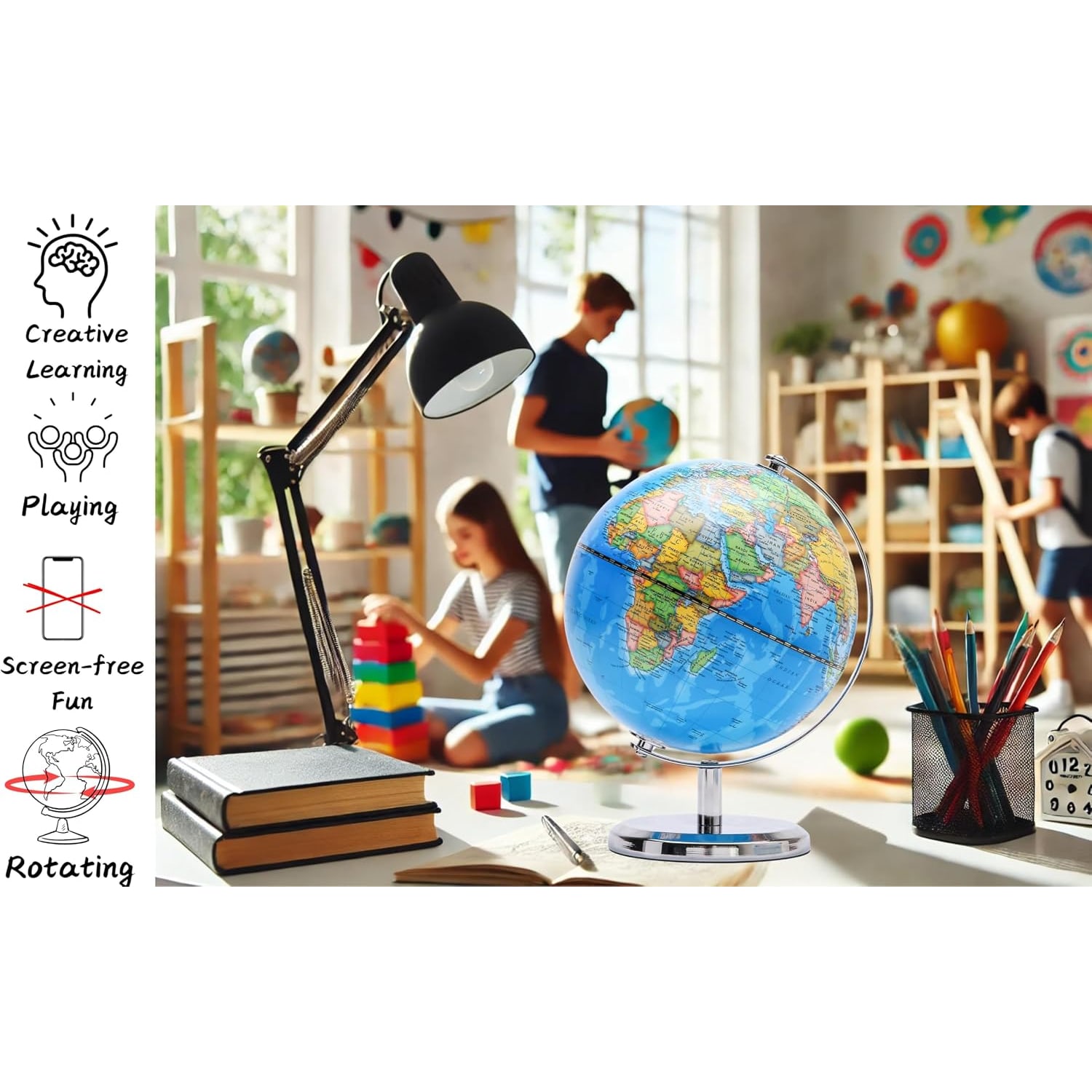
Students and homework desks. Geography assignments, history reading, anything involving "where did this happen". Having the answer within arm's reach beats opening a tab, because opening a tab leads somewhere else. The best globe for homework is simply the one already sitting on the desk.
Home offices. News mentions a port, a strait, a border crossing. You glance over, you spin, you know. It takes four seconds and you stay in the room.
Classrooms and school rooms. The 20 centimetre size works on a bench, travels between rooms in one hand, and survives being turned by a lot of hands.
Shelves that need shape. Bookshelves are all rectangles. A sphere breaks that up. This is a legitimate reason to own one and nobody should feel odd about it.
This globe is recommended for ages 3 and up. It is a reference object, so it works best given a fixed home on a stable surface rather than being carried around.
How to choose between options
Work through four questions.
Map type. Political for countries, borders, capitals and cities. Physical for terrain. If you mostly follow news and travel, political wins.
Size against your space. Measure the spot first. For a bookshelf, you need clearance taller than the 20 centimetre sphere plus the arc and base above it. Overall assembled height is not listed, so leave generous headroom or measure a comparable object before you commit.
Stand material. Steel for a modern, neutral, weighted stand. Timber for a traditional study look. Plastic for lowest cost and lowest stability.
Illumination. Lit globes glow as a lamp and often show a second map layer when switched on. This one has no illumination specified, so it is read by room light like a printed map.
Looking after it
A globe is a printed surface on a curved ball, and it wants to be treated like one.
Dust it with a soft dry cloth. For a mark that will not shift, use a barely damp cloth and dry it straight after. Skip household sprays, solvents and abrasive pads entirely, because those can lift or dull printed map surfaces and there is no way back from that.
Dry the stainless steel after any damp wipe so it does not water spot. Polished steel shows marks easily and cleans up just as easily.
Keep it out of long direct sun. Hours of hard afternoon light will fade printed colour on any globe over a year or two. A spot with good ambient light and no direct beam is ideal.
When you move it, lift from the base rather than grabbing the sphere. The sphere is designed to rotate, not to carry the weight of the whole piece.
The short version
This is a 20cm political world globe on a polished stainless steel arc and base, weighing 1.15 kilograms. It shows countries, political boundaries, capital cities and major cities in clear printing, and it spins freely so you can actually follow a line around the world instead of hopping across page edges.
The size is chosen for desks and shelves rather than floors. The steel stand gives it weight so it stays put, and a look that suits a modern room without trying to be a museum piece.
If you want terrain and mountains, look for a physical map instead. If you want to know which country is which, where the capitals sit, and how far things really are from each other, this is the sort of globe that quietly earns its space.