
The complete guide
How to Choose and Use a Wooden Hundred Board
The problem with the number 100
Ask a young child to count to one hundred and plenty of them can do it. Ask them what one hundred is and the answer gets vague. Counting is a chant. It is a sequence of sounds they have memorised, and memorising a sequence is not the same as understanding a quantity.
This is the gap a hundred board fills. It takes the sequence and spreads it out in front of the child as ten rows of ten. Suddenly there is a shape to it. Row one holds the single digits, row two holds the teens, and from there the pattern just repeats with a different number in front. A child who has only ever chanted the numbers will often go quiet for a second when they first see that laid out, because the pattern was always there and nobody had shown it to them.
The wooden version adds the other half of it, which is touch. Tiles get picked up, turned over, placed, moved and knocked out of line. That physical handling is what makes the number stick for a lot of children, far more than looking at a printed chart on a wall.
How this set works
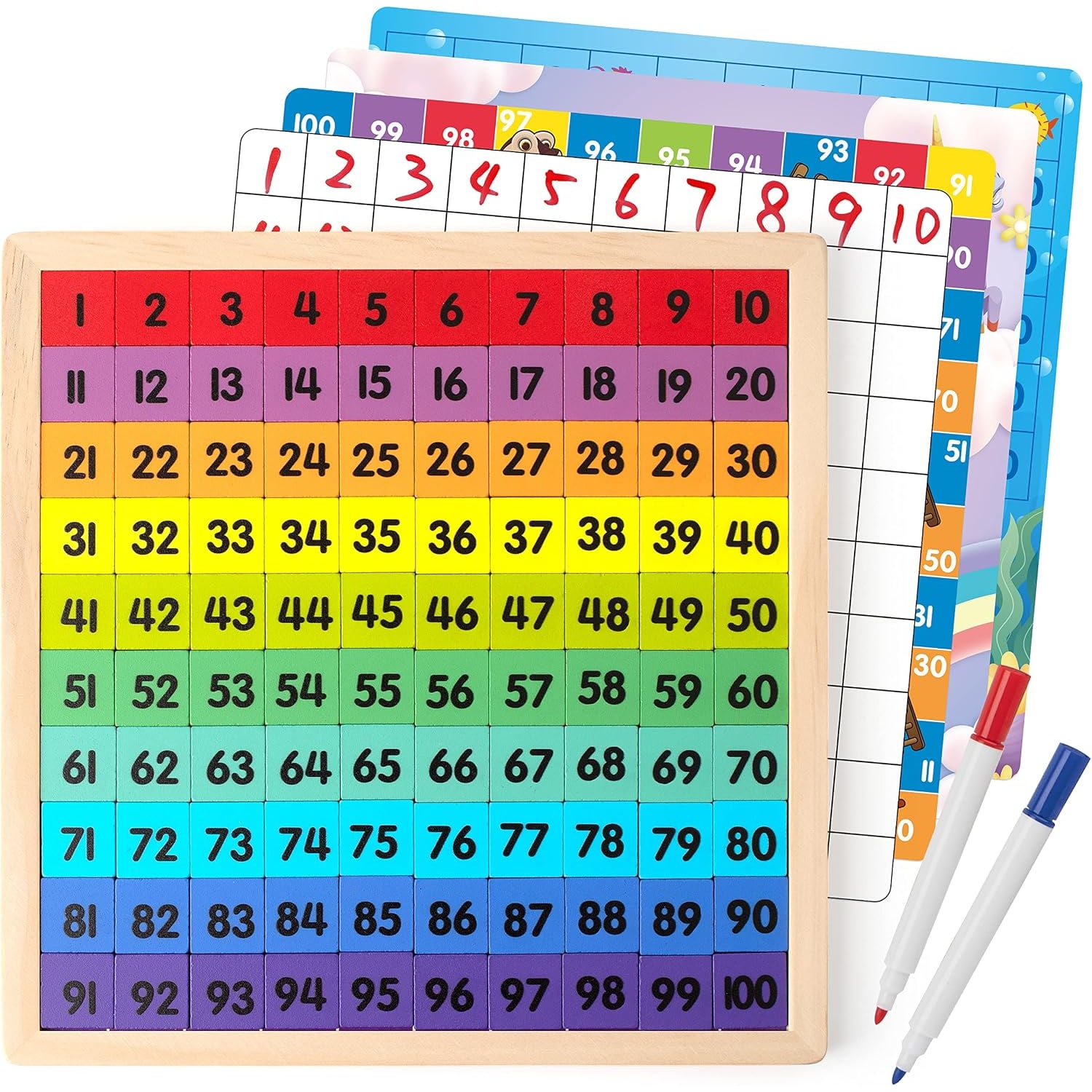
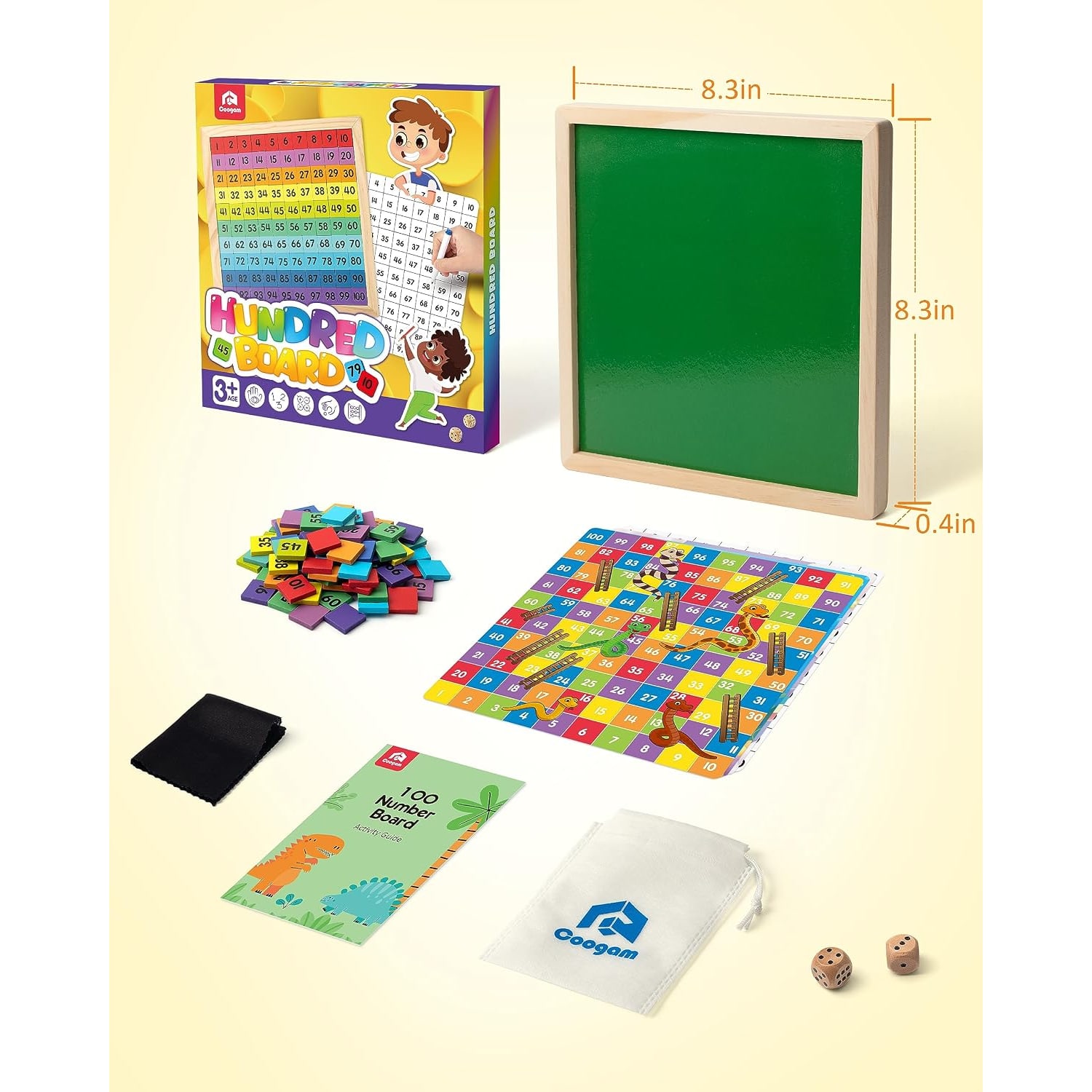
The board is a 20.3 cm square grid, 0.8 cm thick, with a space for each number from 1 to 100. The hundred wooden tiles go into those spaces. They are small, which is deliberate, because a tile that needs two hands to position breaks the rhythm of placing a whole row.
The tiles are grouped in different colours. This is the part people often overlook when comparing a plain number board 1 to 100 with a colour-grouped one. Colour gives the eye something to follow. When a child is partway through filling the grid, the colour bands show them where they are and where the next group starts. It also means you can set tasks like "put out all the tiles of this colour" without having to explain the underlying number rule first. The rule shows itself.
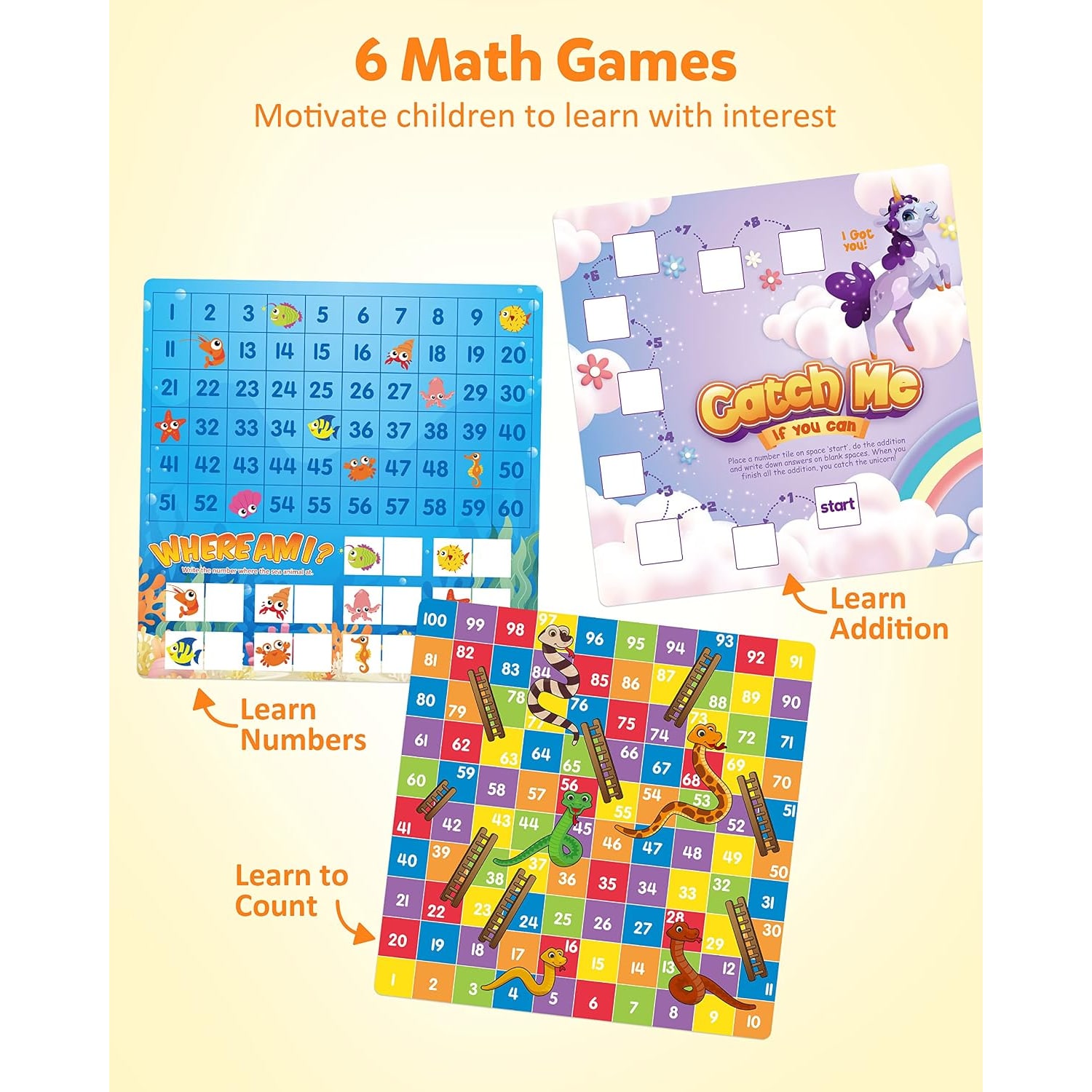
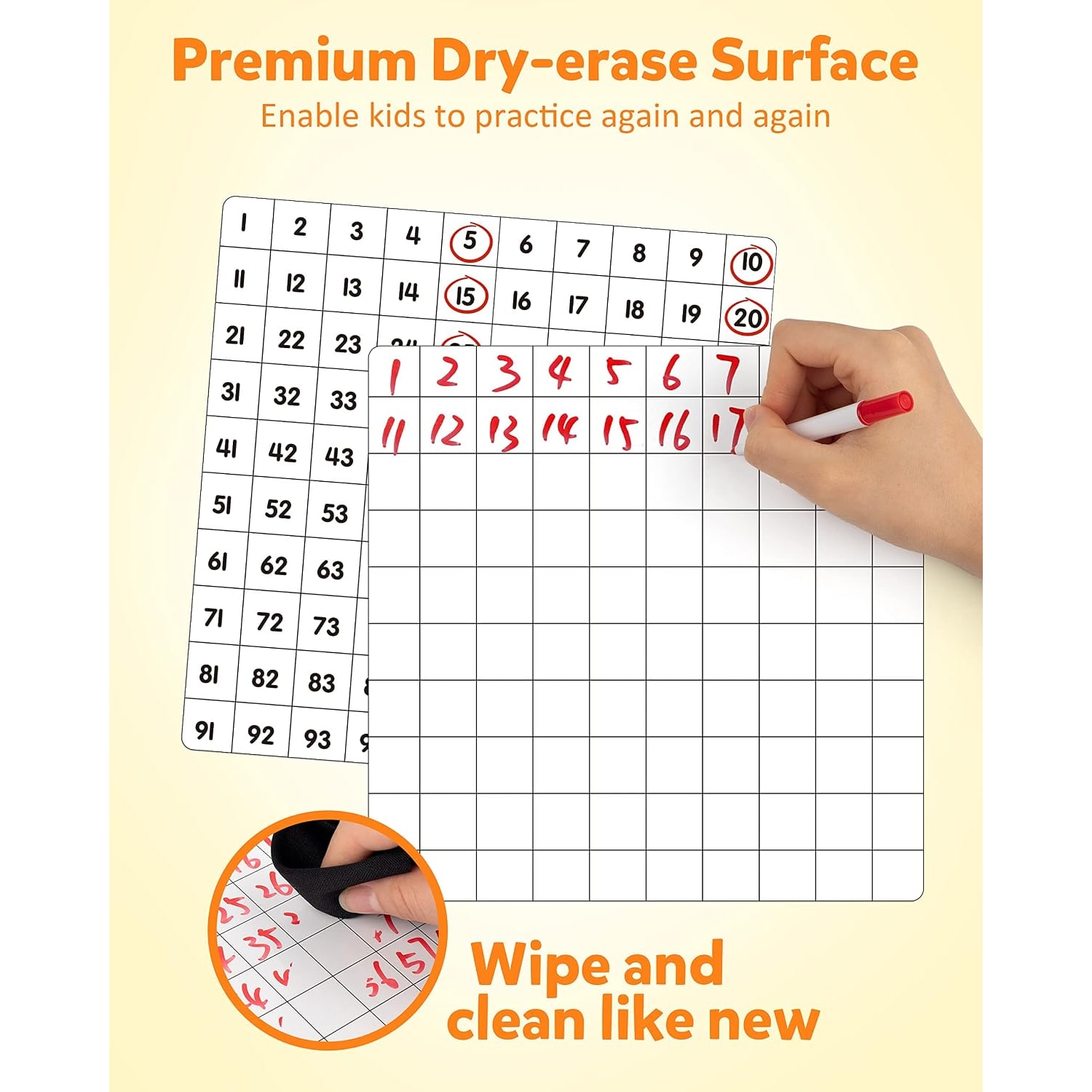
Then there are the extras. Four activity cards carry six suggested games, and a separate game suggestion sheet gives you more to work with. The cards have a dry-erase surface, so you write on them, work something out, wipe with the included cloth, and go again. Two dry-erase markers come in the box. Two wooden dice add a chance element, which is usually what tips an activity from a task into a game. The set is listed as a two-player one, and everything packs into a drawstring bag when you are finished.
No batteries, no charging, no assembly. It comes out of the packaging ready.
Who it suits
This is for ages 3 and up. It contains small parts, so it is not suitable for children under 3, and that is worth taking seriously with hundred tiny tiles in the room.
At the younger end of that range, a child will mostly be doing number recognition. Find the 7. Put the first row in order. Match the tile to the space. That alone is plenty of work and it is where a number recognition board earns its keep.
A bit further along, the board becomes a counting tool. Count on by tens down a column. Start at 23 and move five places. See what happens to the pattern. This is where a maths learning board starts doing something a flashcard cannot, because the child can see the distance they moved, not just hear the answer.
Older again and the same grid supports working with patterns, skip counting and simple arithmetic laid out physically. One of the useful things about a hundred board is that it does not get outgrown quickly. The board stays the same and the tasks you set on it change.
It works at home and it works in a classroom. A home school maths board gets used by one or two children at a time, which matches the two-player listing well. In a classroom it tends to sit in a maths corner as a station that small groups rotate through. The 20.3 cm size suits a desk or a small group table.
How to choose between hundred boards
If you are comparing options, a few things actually matter.
Size is the first. A compact board like this one fits on a kitchen table without taking it over, and at 0.35 kg a child can carry it themselves. Bigger boards look impressive but tend to live in one place because moving them is a job.
Whether the tiles are colour-grouped is the second. Plain boards work, but colour-grouped tiles give you an extra teaching handle at no cost in complexity.
Storage is the third and it is the one people regret ignoring. A set of one hundred small tiles with nowhere to live will shed pieces within a month. The drawstring bag in this set is not a glamorous feature but it is the thing that keeps the set usable in a year's time.
Finally, look at what else is in the box. Dice and dry-erase activity cards mean you have structured things to do from day one. Without them you are inventing every activity yourself, which some people enjoy and others never get around to.
Getting the most out of it
Start simple and resist the urge to run through every activity in the first sitting. Most children get more from ten focused minutes than from an hour that ends in frustration.
A good first session is just filling the board in order while saying the numbers out loud. Do a row at a time if the whole thing feels long. The point is the pattern, not the finish line.
Once that is comfortable, pull out a handful of tiles from a completed board and ask the child to work out which ones are missing. The gaps in the grid give them a visual clue, so they are reasoning rather than guessing.
Then bring in the dice. Roll, move that many tiles along, say where you have landed. Two dice and two players is a straightforward race across the board, and the counting happens without anybody calling it counting.
The activity cards cover six games and are a good source of ideas when you have run out of your own. Keep a marker with the cards so you are not hunting for one mid-session.
Looking after the set
Wooden items ask very little. Wipe the board and tiles with a slightly damp cloth and dry them straight away. Do not soak them and never put them in a dishwasher. The wipe cloth included with the set is best kept for the dry-erase cards, since marker residue on a cloth is not something you want transferring to the tiles.
Store everything in the drawstring bag between sessions. Counting the tiles back in before you tie it up takes well under a minute and is the single habit that keeps a hundred-piece set complete. Keep the bag somewhere dry and out of direct sunlight.
Only use dry-erase markers on the activity cards. Permanent marker will not come off, and the cards are a part of the set you will want for years.
The short version
One hundred is hard to picture and easy to chant. A wooden hundred board turns it into something a child can see and handle, which is why the format has stayed in classrooms for so long.
This set gives you a 20.3 cm square board, 100 colour-grouped wooden tiles, two dice, two dry-erase markers, four activity cards, a game suggestion sheet, a wipe cloth and a drawstring bag. No batteries, no assembly, indoor use, ages 3 and up, and not for children under 3 because of the small parts.
If you want a maths learning board that a child will actually touch rather than look at, this is a sensible place to start.