
The complete guide
Choosing a World Globe That Actually Gets Used
The problem with flat maps
Everyone has had the moment. Someone mentions a country on the news, you picture it on a map, and later you find out it is nowhere near where you thought. Flat maps do that to us. To squash a round planet onto a rectangle, every projection has to stretch something. Usually it is the top and bottom of the world, which is why Greenland looks the size of Africa when it is about a fourteenth of it.
A globe does not have that problem. Shapes stay honest, distances stay honest, and the route from Sydney to London stops looking like a detour and starts looking like a sensible arc. That is the whole case for owning one. It is not nostalgia, it is accuracy.
The second problem is simpler. Maps live in apps now, and apps are good at showing you a street and bad at showing you a planet. Zooming out on a phone gives you a pinched little ball you cannot really read. A physical globe sitting on a desk is always at the right zoom level, always on, and always in the way, in the best sense. Things that are in the way get used.
What 30 centimetres gets you
Globe sizes cluster around a few common diameters, and each one has a job. Small globes around 15 cm are decorative. They look smart on a shelf, but the type is tiny and whole regions compress into a smudge. Floor globes of 40 cm and up are impressive and expensive, and they need a dedicated spot in the room.
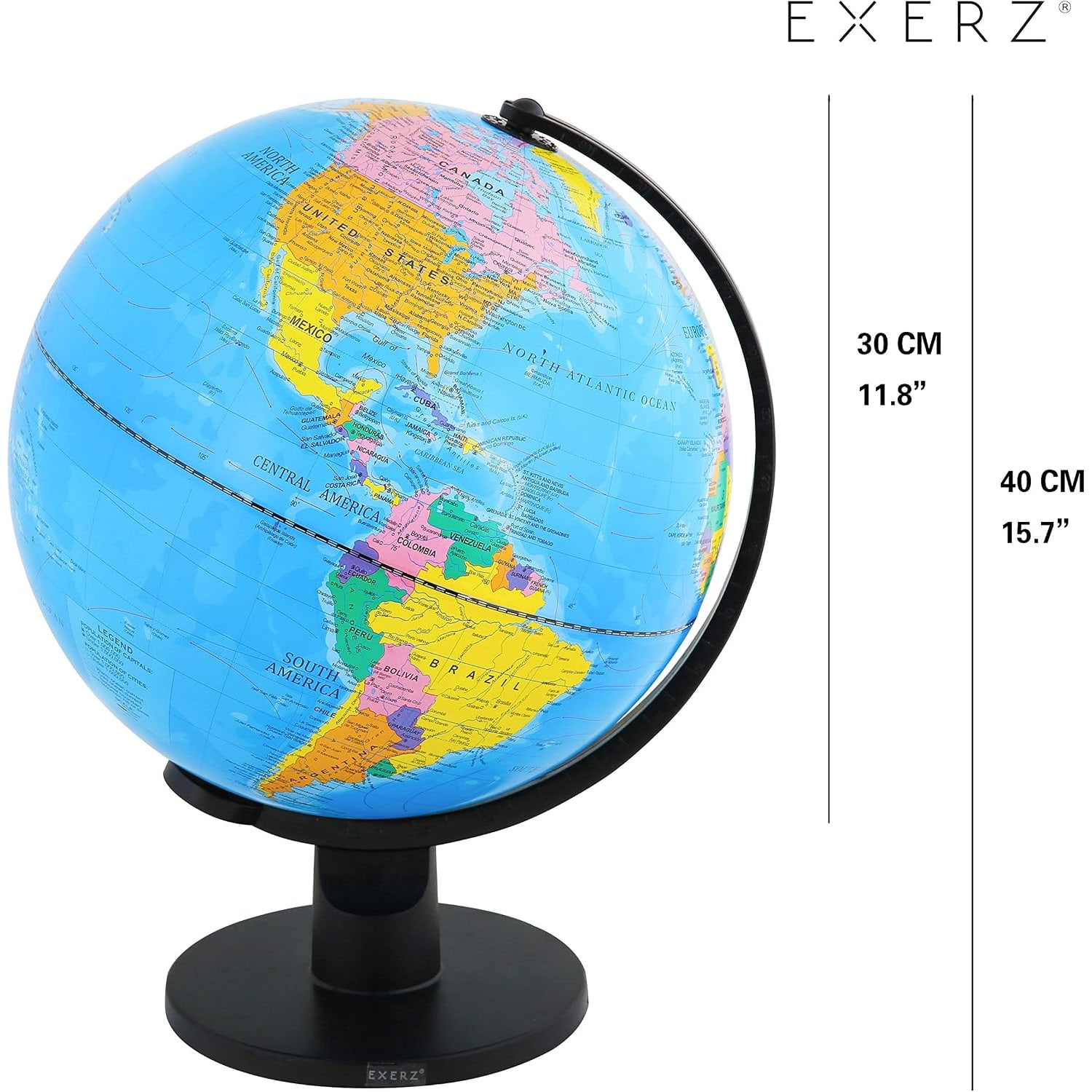
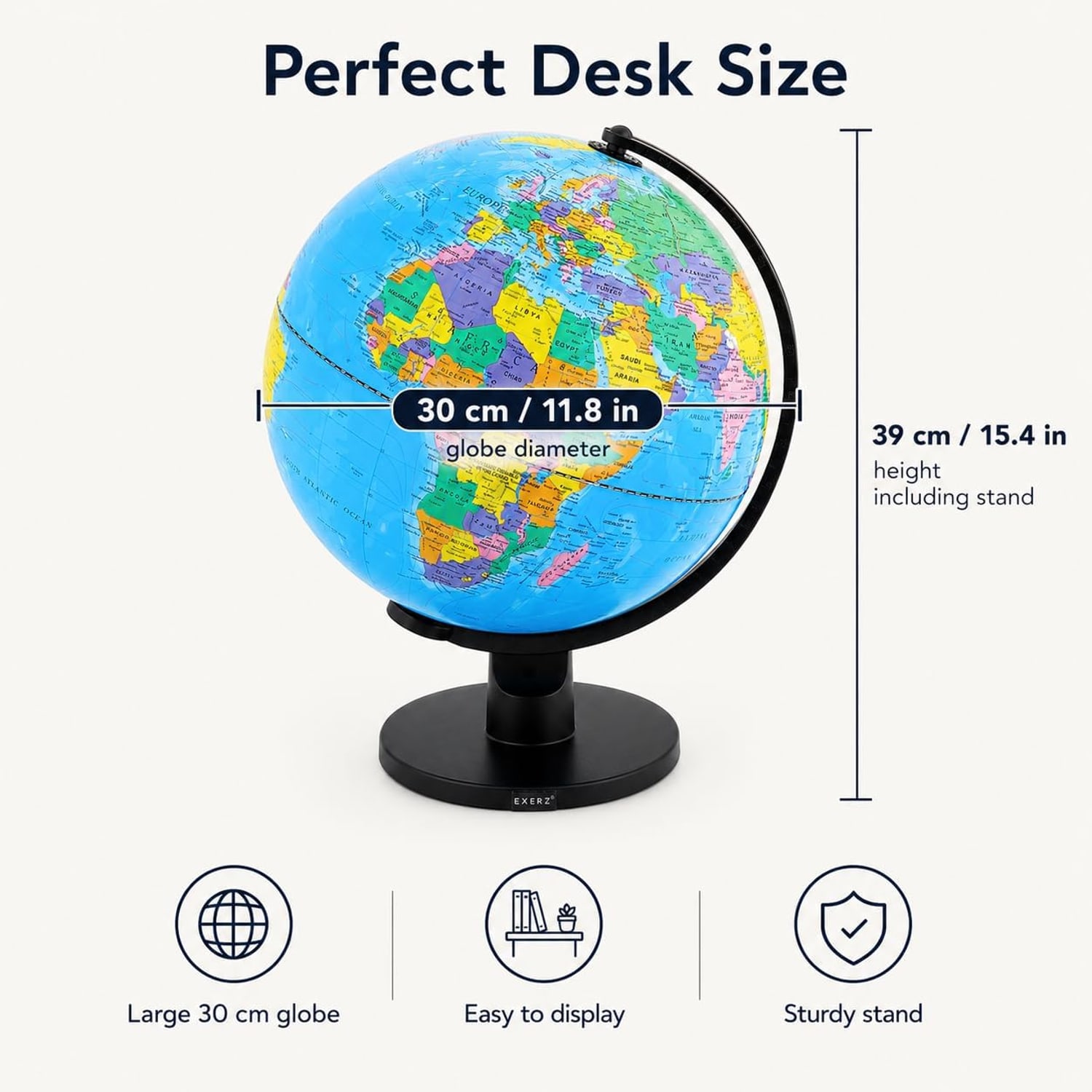
Thirty centimetres sits in the useful middle. It is the size where the printing becomes genuinely readable. Country names in Europe stop overlapping, island chains separate out, and the ocean labels have room to sit flat. You can see roughly a hemisphere at a glance, which is enough to understand a journey without constantly turning the sphere.
It is also the size that works for more than one person. Two or three people can stand round a table and all see the same thing, which matters in a classroom or a kitchen. Anyone shopping for the best classroom globe tends to land here for exactly that reason.
This globe weighs 1.04 kg in total. That is a deliberate balance. Heavy enough that a nudge does not send it skidding, light enough that a child can carry it from a shelf to the table without a fuss.
Political mapping and why it suits most people
Globes generally come in two flavours. Physical maps colour the world by terrain, so you see green lowlands, brown mountains and pale deserts. Political maps colour the world by country, with borders drawn and capitals marked.
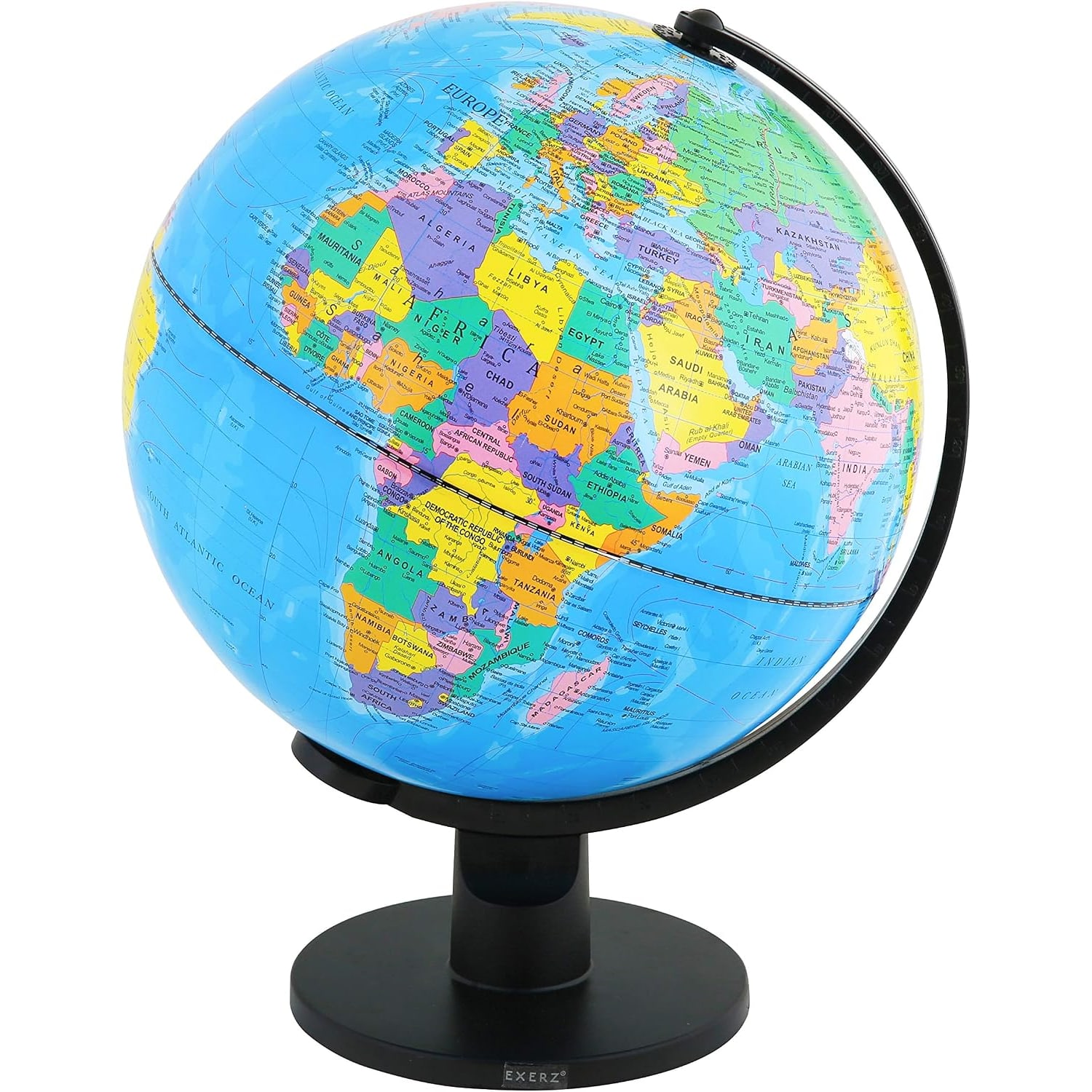
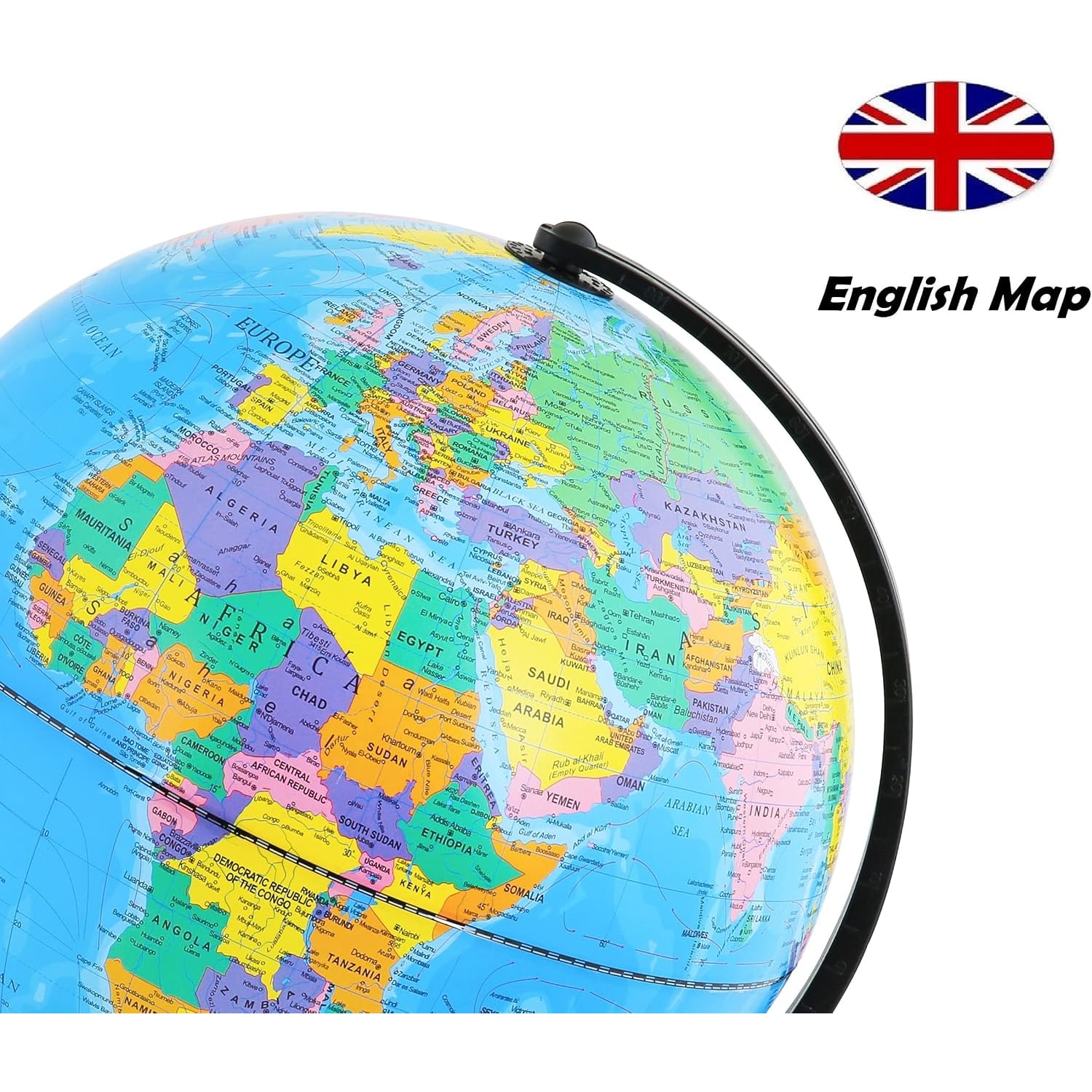
This globe uses a political map in English. It shows countries, capitals, major cities, oceans and borders. For most households that is the right choice, because most of the questions people ask are political ones. Where is that country. What is its capital. Who does it border. Which ocean is that coast on.
Physical mapping is wonderful for geology and climate lessons, but it leaves you guessing on the news. A political globe answers the everyday question faster. If you want terrain detail as well, a wall map or an atlas pairs with it nicely rather than replacing it.
The English labelling is worth noting if you are buying for a bilingual home or a language classroom. Place names will read in English, which is standard for most globes sold in this region but worth knowing up front.
The spin matters more than you think
A globe that does not turn well is a globe that gets ignored. If the sphere sticks, drags, or needs two hands to move, people stop reaching for it after the first week.
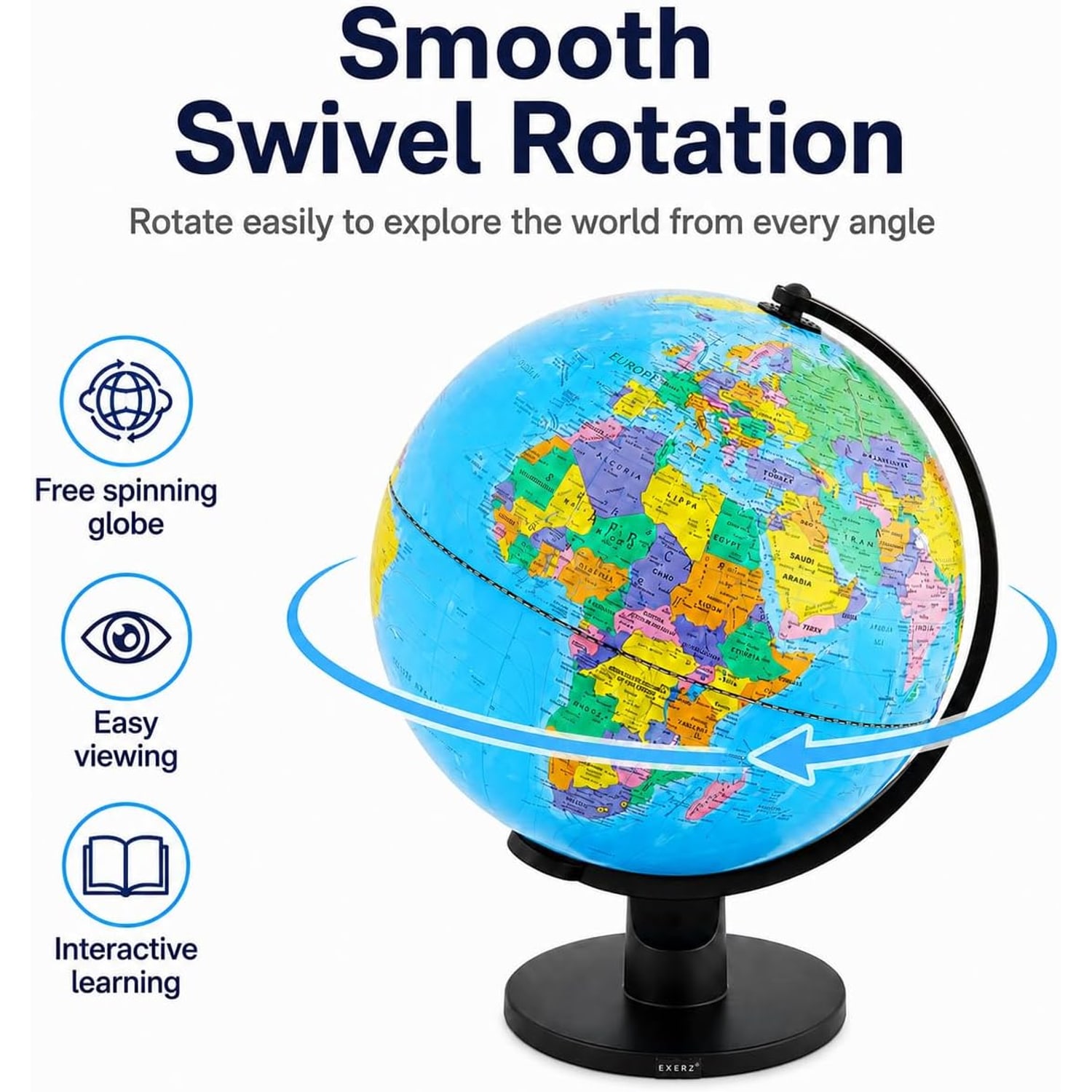
This one is built around a smooth swivel on its base. A light push and it keeps going. That changes how you use it. You can hold a finger on a city and let the world rotate under it, which is exactly how you trace a flight path or follow a shipping route. You can also give it a proper spin and stop it with a fingertip, which is the oldest geography game there is and still a good one.
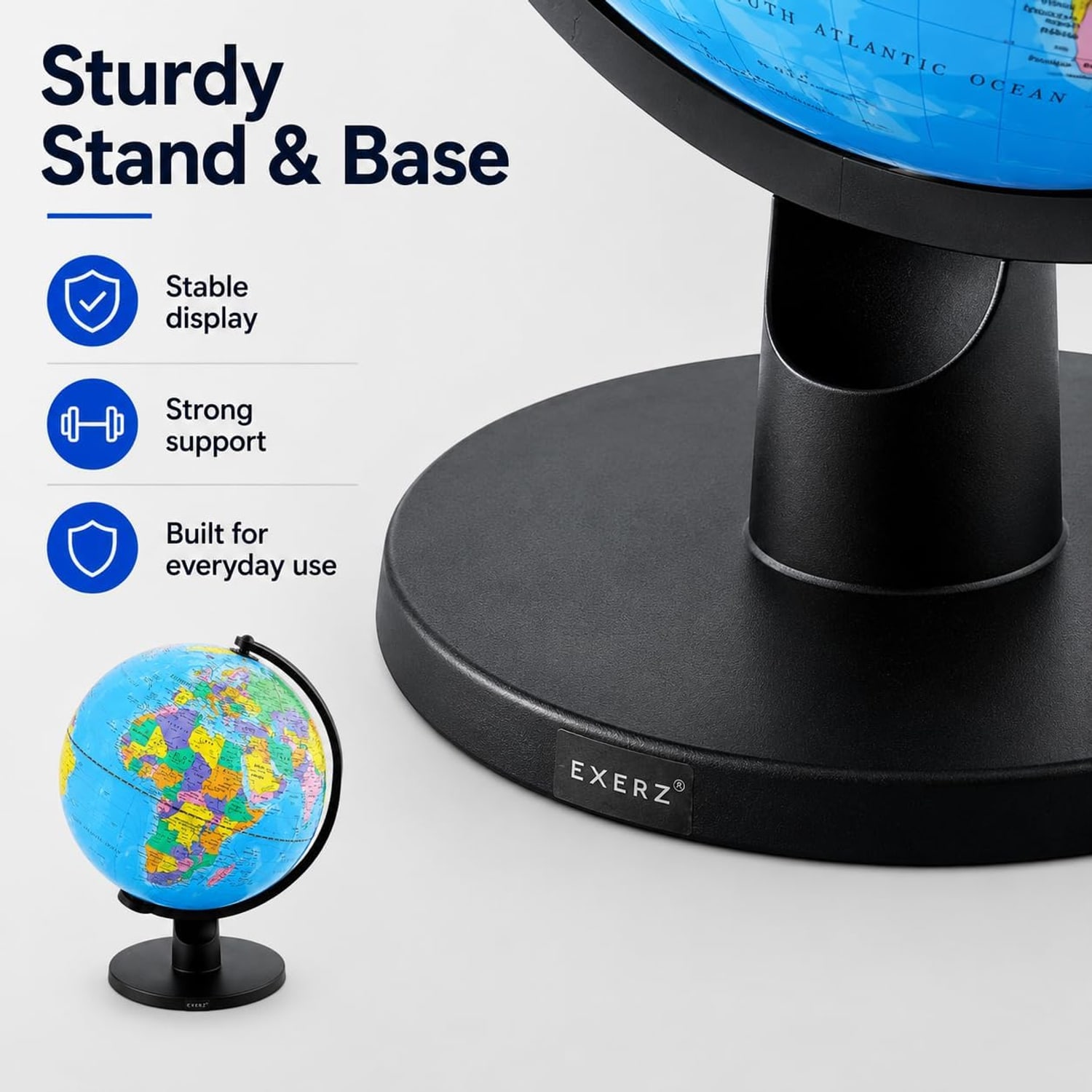
The base is plastic and metal with a polished finish. The metal element in the stand is what gives it that steady, planted feel on a desk. A globe that wobbles every time it is touched is irritating, and the extra mass in the base is what prevents it.
Where to put it
The spot you choose decides whether the globe becomes a tool or an ornament. A few places tend to work well.
A study desk, in the back corner, is the classic. Close enough to grab during homework, far enough not to crowd the writing space. You need roughly a dinner plate of footprint plus headroom for the sphere.
A kitchen or dining shelf works surprisingly well in a family home, because that is where the conversations happen. Someone mentions a place at dinner and the globe is two steps away.
A classroom bench or reading corner suits a group. Keep it at the height where children can reach the sphere without stretching over anything breakable.
Avoid a windowsill in strong afternoon sun. Printed colours fade over time in direct light, and that is true of any printed globe, not just this one. A spot with good light but no baking sunbeam will keep the map looking sharp for years.
Looking after it
Care here is refreshingly simple, because there is nothing to charge, plug in or replace.
Dust it with a soft dry cloth. For marks that will not shift, use a cloth that is barely damp and go gently. The one thing to avoid is household cleaner, solvent or any abrasive pad. Map detail is printed on the surface, and the wrong cleaner can lift or dull it permanently.
Turn the sphere by the sphere, not by grabbing the meridian arc and yanking. The swivel is built for regular use, but like any pivot it lasts longer with a gentle hand than with repeated hard flicks. If you are moving it, lift from the base rather than the globe itself.
That is genuinely the whole routine. A globe treated with a bit of sense will outlast most of the furniture it sits on.
Buying for a child
If this is going to a young learner, a few things help it stick.
Put it somewhere they can reach without permission. A globe behind glass teaches nothing. This one is suitable for ages 3 and up, and the youngest users will mostly spin it and point at colours, which is a fine place to start.
Give it a job. Mark where family members live, trace a holiday route, find the country behind whatever sport or story they are into. A globe that gets used as a reference tool earns its place on the desk far more than one that is only looked at.
Expect it to be handled. That is the point. A sturdy plastic sphere on a weighted base is far more forgiving of daily use than a delicate decorative piece, which is why this build suits a child's desk rather than a display cabinet.
A note on currency of information
No printed globe stays perfectly current. Borders shift, countries rename themselves, and capitals occasionally move. This product does not give a map revision date, so treat the globe as a general reference for shape, position and distance rather than a legal authority on the newest border change. For that, a quick search will always beat any printed object. What a globe gives you that a search never will is the sense of where things actually sit in relation to each other.
The short version
A 30 cm sphere with a readable English political map, a free-spinning swivel and a plastic and metal base, weighing just over a kilogram. One per pack, model EX-GL, made in China. No cables, no batteries, nothing to update.
It is the size that stops being decoration and starts being useful. Put it within reach of the chair where homework gets done, or on the bench where the class gathers, and it will earn its keep. Good globes do not demand attention. They just sit there, quietly correct, until someone needs to know where something is.