

The complete guide
How To Choose A Tabletop Easel With Drawer
The problem with painting flat on a table
Drawing and painting on a flat table feels fine for about twenty minutes. Then your neck starts to ache, the perspective on your drawing skews because you are looking down at the paper on a slant, and the water pot is somewhere behind the sketchbook where you cannot see it. Meanwhile the brushes have rolled to the far edge, a paint tube has vanished under the paper, and half the table is gone.
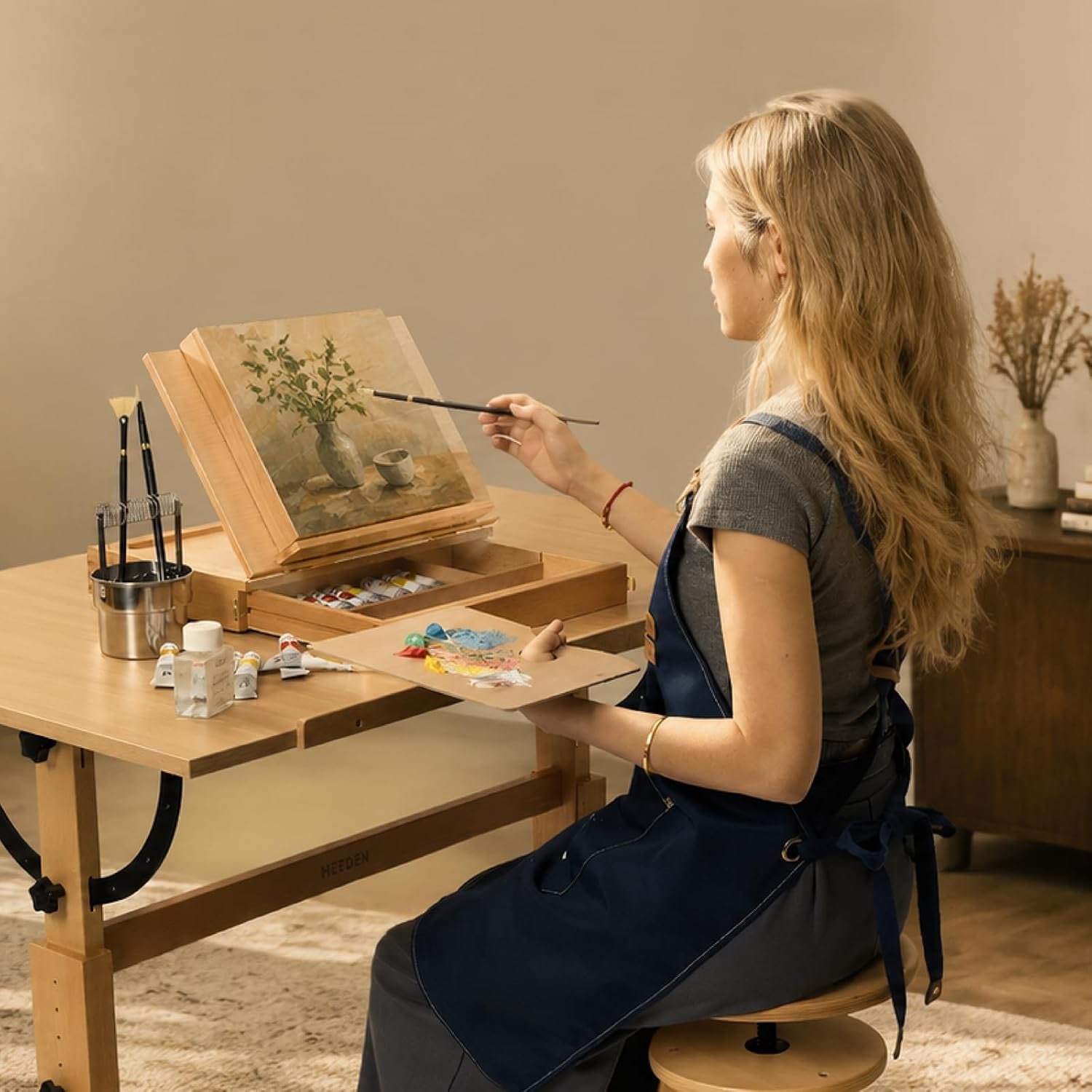
A tabletop easel fixes the angle. A tabletop easel with drawer fixes the angle and the mess at the same time, which is why it has become the default first easel for a lot of people. You get a surface that tilts to meet your eye, and a dedicated home for the things you keep reaching for.
What this easel actually is
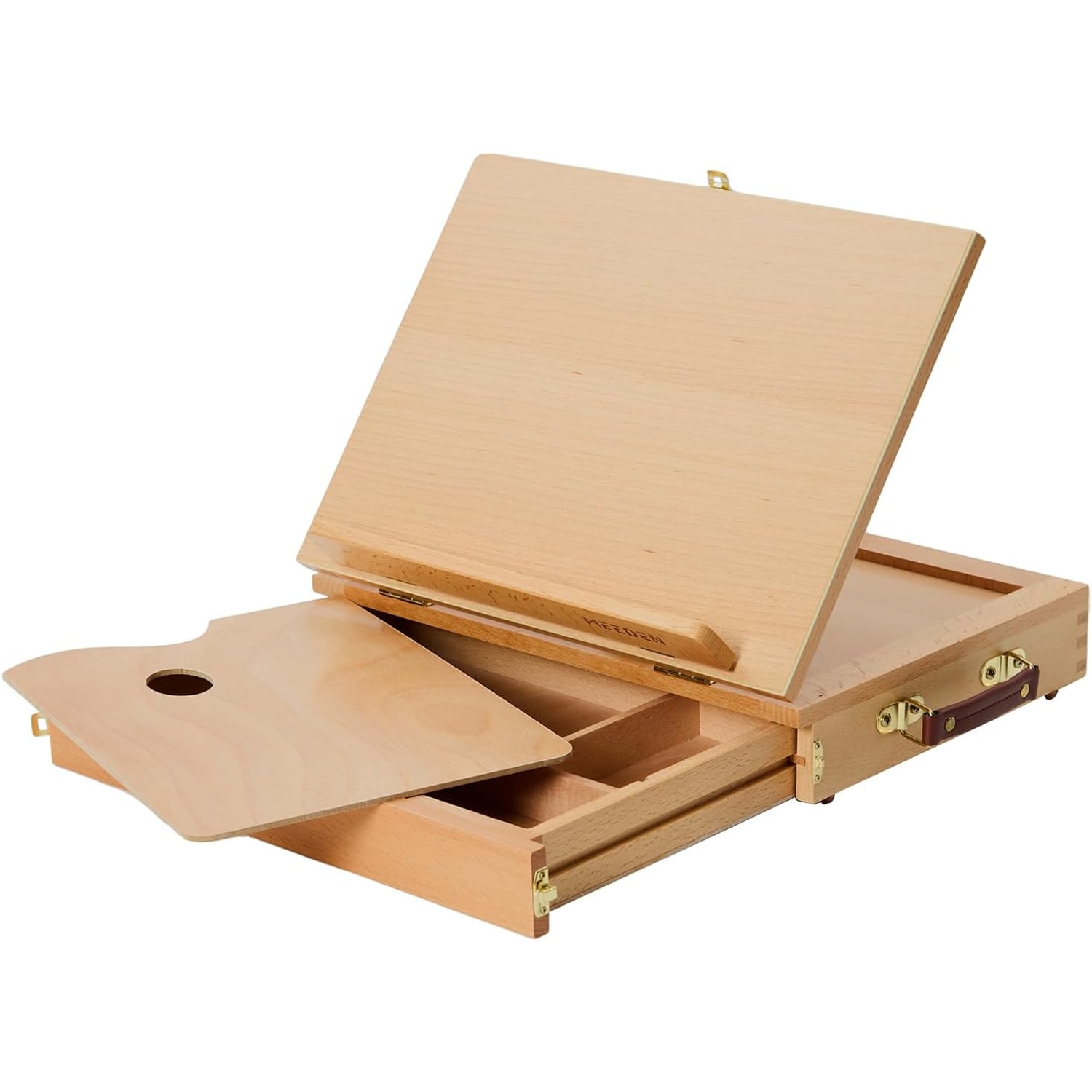
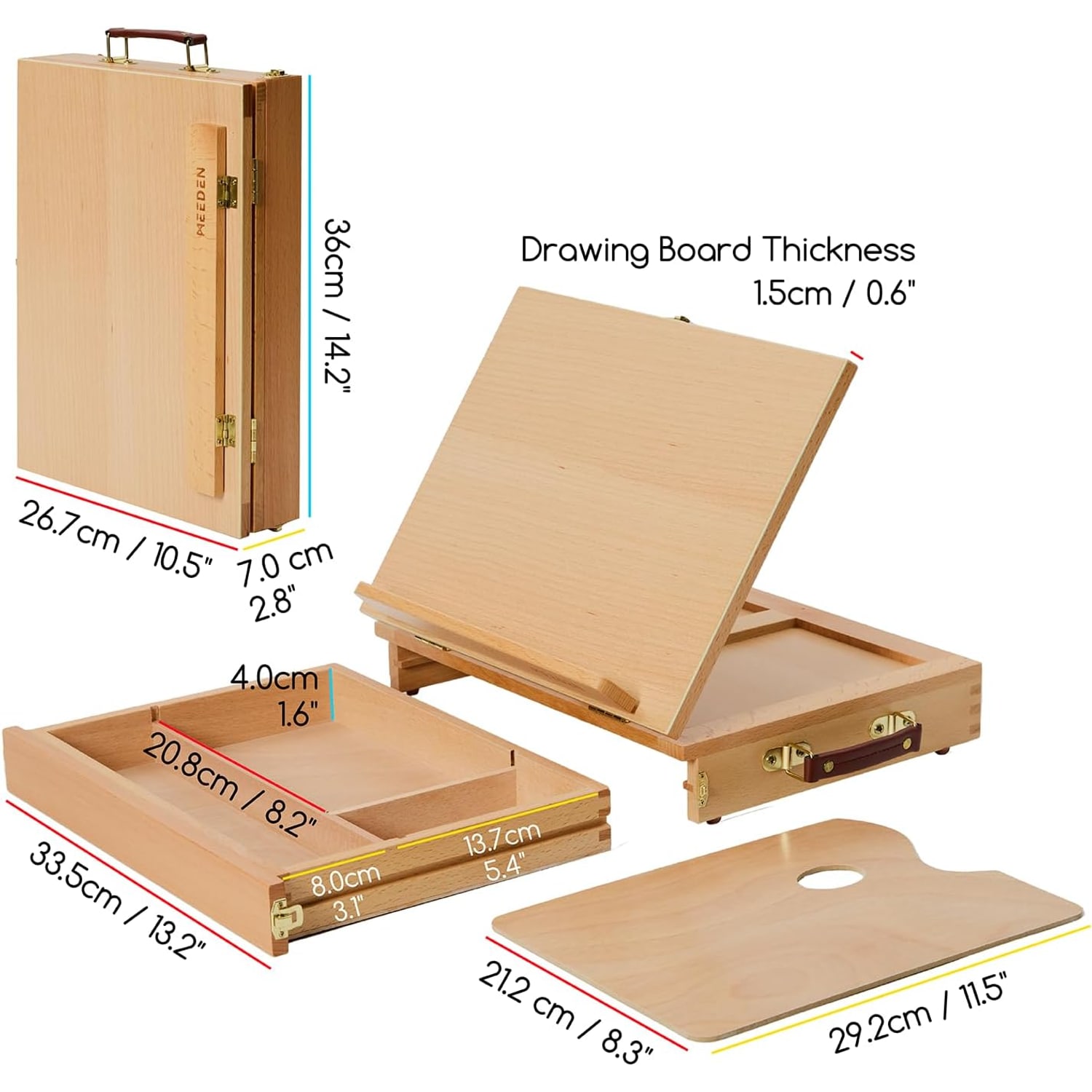
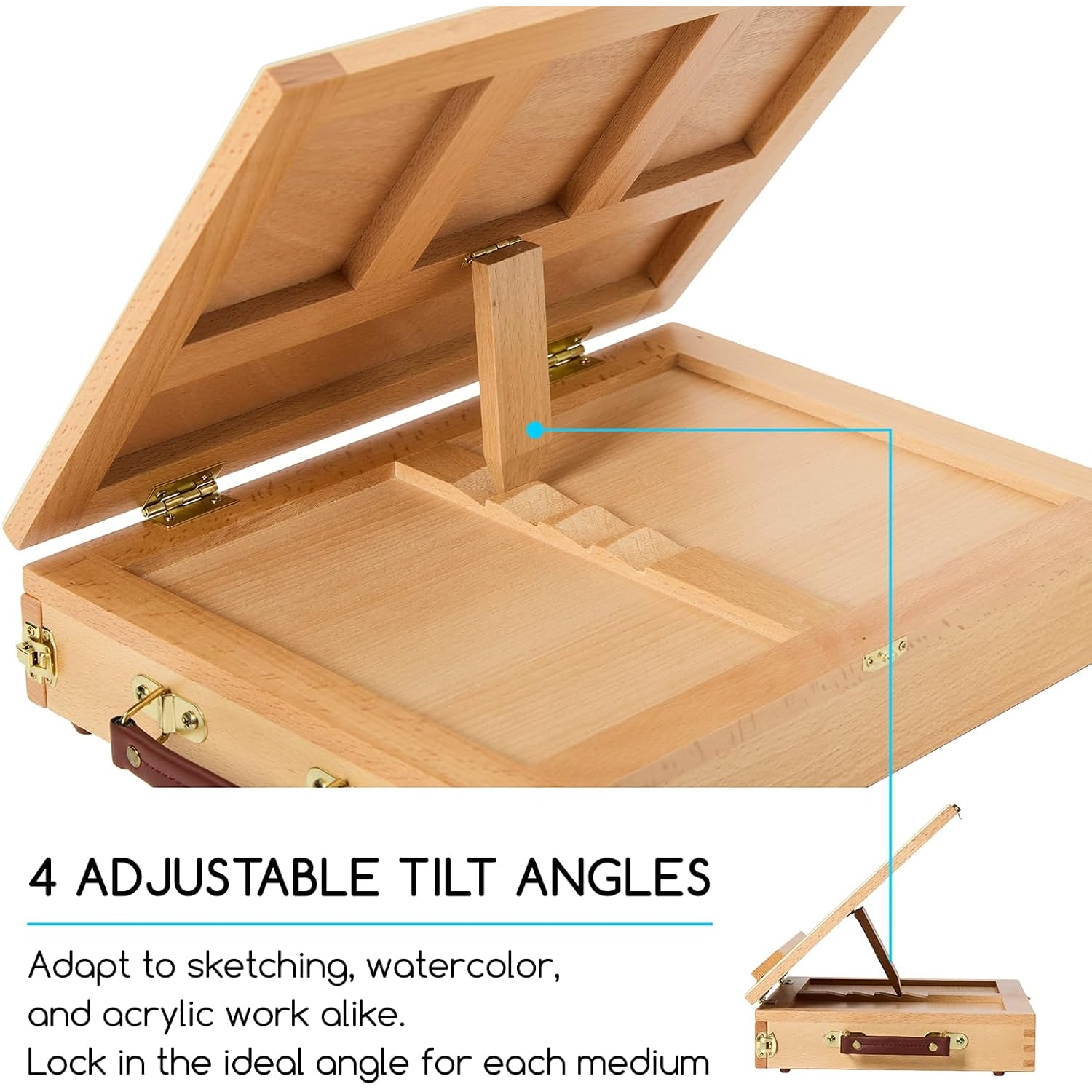
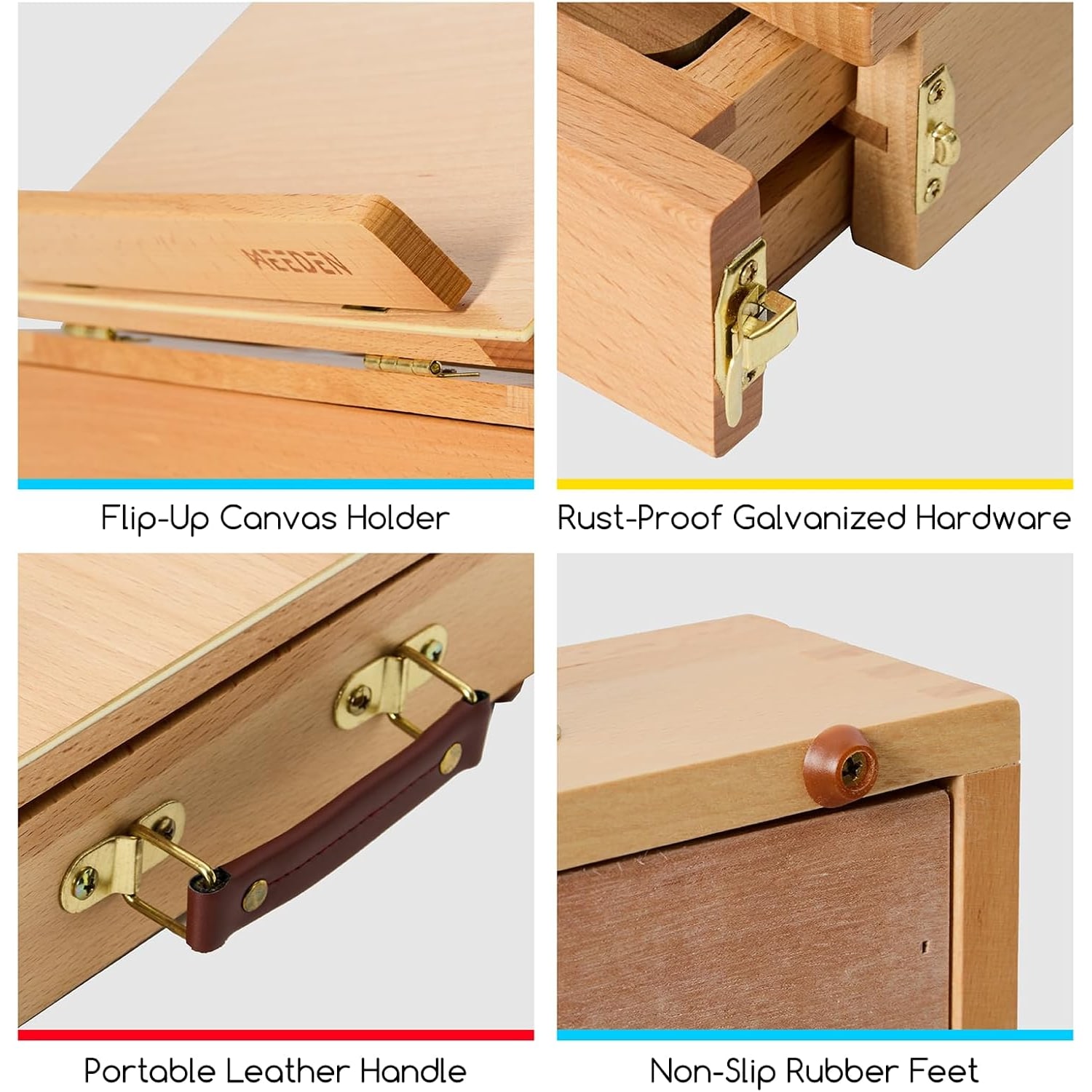
This is a single mast tabletop easel built from beech, finished natural so the grain shows. Folded, it measures 33.7 by 26 by 5.1 cm and weighs 1.68 kg. It has four tilt angles, a divided drawer in the base, reinforced joints, anti-rust hardware, non-slip rubber feet and a leather carry handle on the side. A wooden palette with a thumb hole comes in the box. No assembly is needed.
That list sounds simple, and that is the point. There is nothing to work out. You open it, set the angle, put the sketchbook on the ledge, and start.
Why the tilt angles matter more than people expect
Angle is not a detail. It changes how paint behaves and how your body feels after an hour.
Watercolour wants a low angle. Lay the board nearly flat and a wash sits where you put it. Lift it a little and the colour drifts toward the bottom, which is sometimes exactly what you want for a sky. Too steep and the whole wash runs away from you.
Sketching wants the opposite. An upright board puts your paper roughly at right angles to your line of sight, so what you draw is what you see. Draw flat and you are looking at the paper at a sharp slant, which quietly distorts everything. People often assume they are bad at proportion when really they are just drawing on a surface that lies to them.
Acrylics and gouache sit in the middle. Four positions is enough to cover all of this, and swapping between them during a session takes seconds.
Beech, joints and feet
Material matters on an easel because the thing has to resist you. Every pencil stroke and brush load pushes the board backwards or sideways. A soft or thin frame flexes, and then your lines wobble.
Beech is a dense, close-grained hardwood. It takes screws and hinges firmly and does not dent easily. Combined with reinforced joints, that gives you a frame that holds its set angle instead of slowly collapsing. The anti-rust hardware is a small detail that matters if you rinse brushes beside it or paint near the coast, where damp air gets into everything.
The rubber feet are the part people notice last and appreciate most. Without them, a lightweight easel creeps across a smooth table as you work, and you spend the session nudging it back. With them, it stays put.
Who this suits
This is a hobby and study easel, not a studio workhorse. It suits:
- Beginners who have outgrown drawing flat but are not ready to give up floor space to a full A-frame.
- Art students who need something to carry between home and class, and who want their supplies to travel in the same unit.
- People painting in small flats or shared spaces, where the easel has to disappear between sessions.
- Anyone who paints on holiday, at a cafe table, or at a park bench with a flat surface to work on.
It is less suited to large canvases, heavy impasto work on big boards, or anyone who stands to paint. If you work on anything much bigger than a sketchbook or a modest canvas, you want a floor easel instead. The sensible test is whether the canvas overhangs the base. If it does, the easel becomes top heavy and you are fighting physics.
How to choose between tabletop easels
A few things separate a good one from a frustrating one.
Storage, or not. Plenty of tabletop easels are just a folding frame. They are cheaper and lighter. But if you have ever hunted for a particular brush mid-session, the drawer earns its keep fast. The best art easel with storage is the one that keeps the things you use most within arm's reach without taking up more table.
Adjustment range. One or two fixed angles is limiting. Four covers flat washes through to upright sketching, which is most of what a hobby artist does.
Weight and fold. There is a trade-off. Too light and it slides and tips. Too heavy and it stays on the shelf. At 1.68 kg, and folding to just over 5 cm thick, this one is in the carry-it-without-thinking range.
What comes with it. An included palette sounds minor until you realise the alternative is an extra purchase before you can paint anything. A wooden palette with a thumb hole is the standard shape for a reason: it balances on the hand and does not warp the way thin plastic can.
Material. Hardwood frames last. Thin ply and soft timber do not. Beech is a reasonable middle ground on price and durability.
Setting it up well
Put it on a surface that is genuinely flat and at a comfortable height. Dining tables are often too low if you sit on a standard dining chair, which pushes you into hunching. If you can, work at a desk height that lets your forearms rest level.
Load the drawer by frequency rather than by type. The three or four brushes you reach for constantly should be nearest the front. Tubes you rarely open can live in a separate box. A drawer that is crammed full stops being faster than a pencil case.
Keep a rag or kitchen towel under the water pot, outside the easel footprint. Spills happen, and the quickest way to stain a natural timber frame is to park a full jar on top of it.
Looking after it
Timber care is mostly about keeping water and heat away from it. Wipe the frame with a dry cloth after each session, or a barely damp one if there are marks, then dry it immediately. Do not soak it and never put any part of it in a dishwasher.
Catch paint while it is wet where you can. Dried acrylic in particular grips wood hard, and scraping it off takes the finish with it. On the palette, let a skin form and then lift it with a palette knife. Wooden palettes stain over time and that is normal, not damage.
Store it folded, somewhere dry, away from a radiator or a sunny windowsill. Sustained heat dries timber out and joints can loosen. A shelf in a cupboard is ideal.
Check the hinges every few months. If an angle starts to slip under load, a gentle tighten usually sorts it.
The short version
If you paint or draw at a table and your supplies keep taking over, this does two useful jobs in one small object. It holds your work at a sensible angle, and it gives your brushes and tubes somewhere to live. The beech frame and rubber feet keep it steady, four tilt settings cover watercolour through to sketching, and the whole thing folds to just over 5 cm thick with a handle on the side.
It arrives ready to use with a palette included. Keep the canvas within the footprint, keep water off the timber, and it will quietly do its job for years.